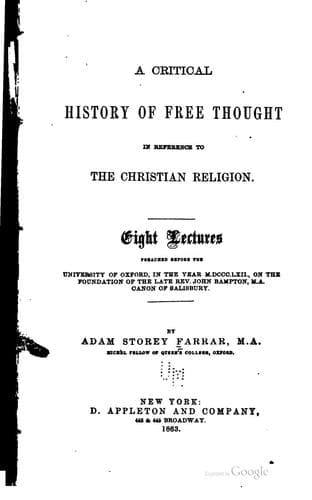
History of Free Thought in Reference to The Christian ReligionFarrar, Adam Storey
History
History of Free Thought in Reference to The Christian Religion
Farrar, Adam Storey
Free thought -- History
fact that a single free responsible being may be of more dignity than the
universe.
Such is the type of a philosophical objector against Christianity, a
little later than the middle of the second century. We meet here for the
first time a remarkable effort of pagan thought, endeavouring to
extinguish the new religion; the definite statements of a mind that
investigated its claims and rejected it. Most of the objections of Celsus
are sophistical; a few are admitted difficulties; but the philosophical
class of them will be seen to be the corollary from his general principle
before explained.
A century intervenes before we meet with the next literary assailant,
Porphyry. In the interval the new reactionary philosophy has fully taken
root, and the fresh attack accordingly bears the impress of the new
system.
The chief objections made in the intervening period, as we collect them
from the apologies, were such as belongs fitly to a transitional time,
when Christianity was exciting attention but was not understood;(195) and
are chiefly the result of the second of the tendencies before named, viz.,
either of popular prejudice, or of the political alarm in reference to the
social disorganization likely to arise out of a large defection from the
religion of the empire, which expressed itself in overt acts of
persecution on the part of the state. (15) Both equally lie beyond our
field of investigation; the one because it does not belong to the
examination of Christianity made by intelligent thought; the other because
it is the struggle of deeds, not of ideas, which only have an interest for
us, if, as in Julian’s case hereafter, the acts were dictated by the
deliberate advice of persons who had attentively examined Christianity.
Public-domain text, read in full here on John Shaqi.
Reviews
Reviews
No reviews yet
Be the first to share your thoughts on this work.
Elsewhere in the archive
Join the Discussion
Join the discussion
Sign in to leave a comment or review.
Sign InorCreate an account