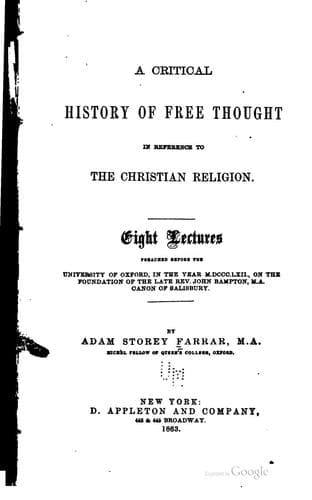
History of Free Thought in Reference to The Christian ReligionFarrar, Adam Storey
History
History of Free Thought in Reference to The Christian Religion
Farrar, Adam Storey
Free thought -- History
Having thus defamed the Christians, he passes to the examination of the
Christian doctrine, in its form, its method, and its substance. His
æsthetic sense, ruined with the idolatry of form, and unable to appreciate
the thought, regards the Gospels as defective and rude through
simplicity.(179) The method of Christian teaching also seems to him to be
defective, as lacking philosophy and dialectic, and as denouncing the use
of reason.(180) Lastly, he turns to the substance of the dogmas
themselves. He distinguishes two elements in them, the one of which, as
bearing resemblance to philosophy or to heathen religion, he regards as
incontestably true, but denies its originality, and endeavours to derive
it from Persia or from Platonism;(181) resolving, for example, the worship
of a human being into the ordinary phenomenon of apotheosis.(182) The
other class of doctrines which he attacks as false, consists of those
which relate to creation,(183) the incarnation,(184) the fall,(185)
redemption,(186) man’s place in creation,(187) moral conversions,(188) and
the resurrection of the dead.(189) His point of view for criticising them
is derived from the fundamental dualism of the Platonic system; the
eternal severance of matter and mind, of God and the world; and the
reference of good to the region of mind, evil to that of matter. Thus, not
content with his former attack on the idea of creation in discussion with
the Jew, he returns to the discussion from the philosophical side. His
Platonism will not allow him to admit that the absolute God, the first
Cause, can have any contact with matter. It leads him also to give
importance to the idea of δαίμονες, or divine mediators, by which the
chasm is filled between the ideal god and the world;(190) not being able
otherwise to imagine the action of the pure ἰδέα of God on a world of
matter. Hence he blames Christians for attributing an evil nature to
demons, and finds a reasonable interpretation of the heathen worship.(191)
The same dualist theory extinguishes the idea of the incarnation, as a
degradation of God; and also the doctrine of the fall, inasmuch as
psychological deterioration is impossible if the soul be pure, and if evil
be a necessary attribute of matter.(192) With the fall, redemption also
disappears, because the perfect cannot admit of change; Christ’s coming
could only be to correct what God already knew, or rectify what ought to
have been corrected before.(193) Further, Celsus argues, if Divinity did
descend, that it would not assume so lowly a form as Jesus. The same
rigorous logic charges on Christianity the undue elevation of man, as well
as the abasement of God. Celsus can neither admit man more than the brutes
to be the final cause of the universe; nor allow the possibility of man’s
nearness to God.(194) His pantheism, destroying the barrier which
separates the material from the moral, obliterates the perception of the
Public-domain text, read in full here on John Shaqi.
Reviews
Reviews
No reviews yet
Be the first to share your thoughts on this work.
Elsewhere in the archive
Join the Discussion
Join the discussion
Sign in to leave a comment or review.
Sign InorCreate an account