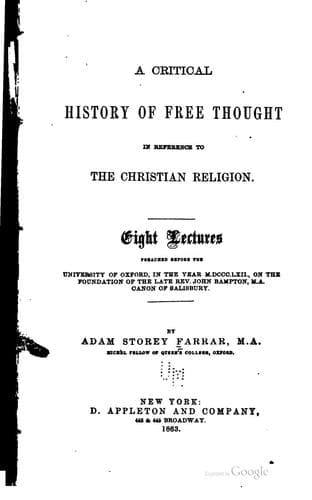
History of Free Thought in Reference to The Christian ReligionFarrar, Adam Storey
History
History of Free Thought in Reference to The Christian Religion
Farrar, Adam Storey
Free thought -- History
The intellectual action in this crisis is marked by four forms;—(1) the
criticism created by the scholastic philosophy, which has been thought to
mark in Abélard the commencement of doubt; (2) the introduction of the
idea of progress in religion, in the sense that Christianity is to be
replaced by a better religion; (3) the idea of the comparison of
Christianity with other religions, so as to obliterate its exceptional
character; (4) the traces of disbelief in the doctrine of immortality. The
two former are free thought as doubt, the two latter as disbelief.
It will be necessary, for illustrating the first of those forms, to
explain the nature of the scholastic philosophy, so far as to show how it
might become the means of producing heresy or scepticism, when applied to
theology.
Scholasticism is the vague name which describes the system of inquiry
common in the middle ages.(254) In truth it marks a period rather than a
system; a method rather than a philosophy. In spite of difference of form,
it links itself with the speculations of other ages in community of aim,
in that it strove to gain a general philosophy of the universe, to reach
some few principles which might offer an interpretation of all
difficulties.
In the present age the science which attempts this grand problem is
denominated Logic, or Metaphysics, according to the different sphere which
it covers.(255) But in the middle ages these two fields were not clearly
distinguished; in the same manner as in the Διαλεκτικὴ of Plato, method
and the realities attained by method were not separated.(256) Yet it was
mainly in reference to the former that scholasticism wears the aspect of a
method, and to the latter the aspect of a philosophy. Adopting deduction
as the type of a perfect science, it assumed its data partly on the ground
of innate ideas, partly from the truths of revelation, partly from the
metaphysical dicta of Aristotle; and from these principles attempted to
work out deductively a solution of universal nature. It was the Σοφία of
Aristotle executed from a Christian point of view. In respect to the
logical method there was a general agreement of opinion, but difference of
system arose in the metaphysical. The form that the problem of science
then assumed was peculiar. Instead of examining the data from which
deduction starts, with a view of finding their subjective certainty as
thoughts, the inquirers strove to settle the problem of their objective
nature as things. The question asked was this: Are the genera and species
which the mind contemplates, in its attempts to classify and interpret
phenomena, real in nature, or produced only by human thought and speech? A
comparison with the modern mode of investigation will explain the
importance which the question possessed, and the reason why it monopolized
the entire field of inquiry.
Public-domain text, read in full here on John Shaqi.
Reviews
Reviews
No reviews yet
Be the first to share your thoughts on this work.
Elsewhere in the archive
Join the Discussion
Join the discussion
Sign in to leave a comment or review.
Sign InorCreate an account