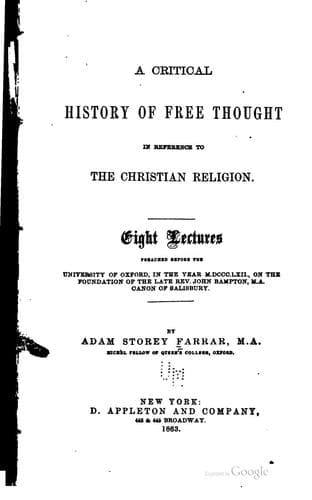
History of Free Thought in Reference to The Christian ReligionFarrar, Adam Storey
History
History of Free Thought in Reference to The Christian Religion
Farrar, Adam Storey
Free thought -- History
The progress of discovery has forced upon us a subdivision of the sciences
into two classes, unknown in the middle ages; in one of which we discover
causes; in the other, in which we are unable to find causes, we rest
content with classification by species and genera. In the former we
discover antecedents, in the latter types.(257) But in mediæval science,
as in Greek, the latter class was regarded as the sole form of all perfect
science. Hence the reason will appear why the question as to the true
nature of genera and species had a monopoly of the field of inquiry; and
also why the theory of predication was exalted into the most important
part of logic.(258) Those who thought that genera had a real existence as
essences apart from man’s mind and from nature, were denominated Realists:
those who denied to them any real existence, and considered them to be a
common quality labelled by a common name, were Nominalists: those who held
the intermediate view, and assumed them to exist, not only as artificial
names but also as general classes in the human mind, were Conceptualists.
With the realist, classification was not arbitrary, but true and
determined for man. With the nominalist and conceptualist it was created
by man, and amenable to correction.
The question, though now relegated from metaphysical to physical science,
has still sufficient importance to enable us to perceive likewise the
reason why these different theories could be the means of dividing men
into parties. The bitterness with which a zoological inquiry of analogous
character into the perpetuity of natural species(259) has been lately
assailed may enable us to realize the earnestness shown on this point in
the middle ages. The question, as viewed by the schoolmen, was really the
fundamental one as respects knowledge; and the opinions on it are the
counterpart to those which relate to the tests of truth and the nature of
being in modern metaphysics. The spirit of realism was essentially the
spirit of dogmatism, the disposition to pronounce that truth was already
known.(260) Nominalism was essentially the spirit of progress, of inquiry,
of criticism. Realism was in spirit deductive, starting from accepted
dogmas: Nominalism was in spirit, though not in form, inductive. It tested
classifications, and admitted opportunities for the existence of doubt.
“Believe that you may know,” was the expression of the former: “Know that
you may believe,” that of the latter.(261)
Public-domain text, read in full here on John Shaqi.
Reviews
Reviews
No reviews yet
Be the first to share your thoughts on this work.
Elsewhere in the archive
Join the Discussion
Join the discussion
Sign in to leave a comment or review.
Sign InorCreate an account