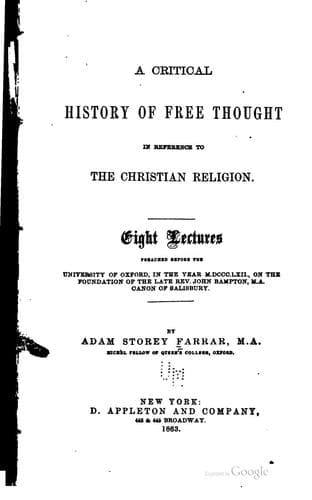
History of Free Thought in Reference to The Christian ReligionFarrar, Adam Storey
History
History of Free Thought in Reference to The Christian Religion
Farrar, Adam Storey
Free thought -- History
contradictions, recalls, for example, the early paradoxes on motion which
Zeno presented for the purpose of compelling acquiescence in the Eleatic
teaching,(276) or the series of antinomies which Kant has given, as
problems insoluble theoretically, but capable of harmony when viewed on
the moral side.(277) In truth it is the mark, either, as in one of these
cases, of the first awakening of the mind to curiosity; or, as in the
other, of the last limit at which curiosity is compelled to pause.
Abélard’s method is like that which is observable in Socrates, and in
those early dialogues of his disciple Plato, in which the pupil is working
in his master’s manner, wherein difficulties are propounded without being
solved. The hearer is cross-questioned, with the view of being made to
feel the necessity of possessing knowledge; and a method is offered to him
by which he is to find the solution of problems for himself.(278) In this
view Abélard’s doubt is really the inquiry which is the first step to
faith; the criticism which precedes the constructive process, the negation
before affirmation.
While its form may be regarded as an embodiment of the scholastic method,
the manner of handling marks the commencement of modern biblical
criticism. The suggestions which he offers(279) in reference to false
readings of manuscripts, the spuriousness of books, and the temporary
character of the author’s sentiments, as elements in determining the
reality of a contradiction, or the necessary rejection of a passage on
grounds of dogmatic improbability, mark a sagacity which has been
perfected into a science by the growth of modern criticism. Thus far we
have only the elements of inquiry and criticism which enter into doubt;
yet it would be unfair to deny that something of unbelief may have been
found in a restless care-worn spirit like that of Abélard; and if any one
thinks that he intended in his work to leave the reader with the
impression that the solution is impossible, or that the doubter’s side is
the stronger, then we may consider him to have been an unbeliever, and
regard his teaching as an example, often witnessed in later times, of a
concealed irony, which, while pretending to accept revelation, has
represented its evidence as insufficient, and its doctrines as unprovable.
If however he be taken to be a sceptic, it is only the infancy of doubt.
It is unlike the bitter disbelief shown by the early antichristian
writers, or by the doubters of modern times. Whatever was valuable in the
free thought of Abélard outlived his time. The spirit of inquiry which
spoke through him, continued to operate in his successors.(280) His method
was even adopted by his opponents. His follower, Arnold of Brescia,
carried free thought from ideas into acts, and suffered martyrdom in a
premature struggle against the papal church.(281) Being dead, Abélard yet
spoke, both politically and philosophically; and his character remains as
Public-domain text, read in full here on John Shaqi.
Reviews
Reviews
No reviews yet
Be the first to share your thoughts on this work.
Elsewhere in the archive
Join the Discussion
Join the discussion
Sign in to leave a comment or review.
Sign InorCreate an account