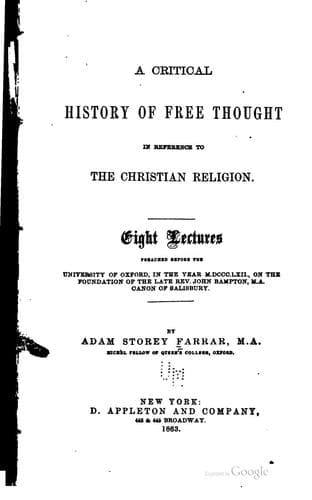
History of Free Thought in Reference to The Christian ReligionFarrar, Adam Storey
History
History of Free Thought in Reference to The Christian Religion
Farrar, Adam Storey
Free thought -- History
The great work which has laid Abélard open to the latter charge merits a
brief notice. It was entitled the _Sic et Non_, and remained unpublished
in the public documents of France till recent years.(269) It is a
collection of alleged contradictions, which exist on a series of topics,
which range over the deepest problems of theology, and descend to the
confines of casuistry in ethics.(270) In the discussion of them Abélard
collects passages from the scriptures and from the fathers in favour of
two distinctly opposite solutions. He has however prefixed a prologue to
the work, which ought to be taken as the explanation of his object.(271)
He insists in it on the difficulty of rightly understanding the scriptures
or the fathers, and refers it to eight different causes;(272) advising
that when these considerations fail to explain the apparent contradictions
of scripture, we should abandon the manuscripts as inaccurate, rather than
believe in the existence of real discrepancies. He draws also a broad
distinction between canonical scripture and other literature, strongly
affirming the authority of the former.
Is this work sceptical? Is it designed under a fair show to serve the
purpose of unbelief? Or is it merely an instance of the awakening of the
spirit of inquiry, the free criticism exercised by nominalism, the desire
to prove all dogmas by reason? In other words, was the freethinking of
Abélard rationalism, or was it merely Protestantism and theological
criticism?
These questions have met with different answers. The Benedictine editors,
viewing his condemnation by St. Bernard as parallel to that of the
biblical critic R. Simon(273) by Bossuet, declined to publish the
manuscript of his work.(274) More recent inquirers, especially the
philosophical critic Cousin, have regarded Abélard with a favourable eye.
They consider his treatises merely to be a provisional scepticism,
fortifying the mind against premature solutions. Some would even claim him
as an early protestant, as the first of the line of men whose spirits,
while fretting under the dogmatic teaching or the political centralization
of the Western church, have unhesitatingly bowed before the authority of
scripture.(275) Possibly these several views contain elements of truth.
Abélard’s character was complex, and the purpose of his book equally so.
He embodied a movement, and experience had not yet taught men to
distinguish in it the boundaries which separated the provinces of free
thought. The argument in favour of scepticism drawn from the form of his
work seems unfair. The statement of a series of paradoxes is lawful, if a
solution of them be offered, or an explanation of the reason why a
solution is impossible. The disputative, dialectical tone which assists in
the work was the ordinary mode of instruction in the mediæval
universities, and finds a parallel in the method of thought observable in
other ages. Abélard’s statement of paradoxes, of an unsolved mass of
Public-domain text, read in full here on John Shaqi.
Reviews
Reviews
No reviews yet
Be the first to share your thoughts on this work.
Elsewhere in the archive
Join the Discussion
Join the discussion
Sign in to leave a comment or review.
Sign InorCreate an account