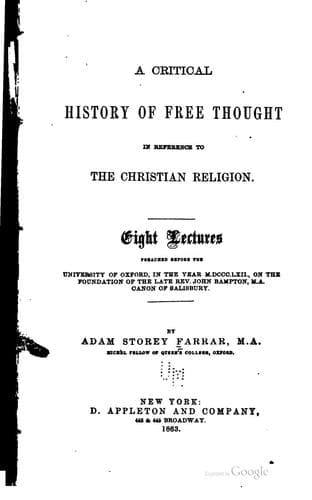
History of Free Thought in Reference to The Christian ReligionFarrar, Adam Storey
History
History of Free Thought in Reference to The Christian Religion
Farrar, Adam Storey
Free thought -- History
The disbelief of immortality was however too obvious a temptation in a
corrupt age, as well as too generally spread, especially in the next
century, to be wholly attributable to the subtle influence of the doctrine
of absorption of the Arabic philosophy. A mediæval English poet(297)
attributes incredulity to the higher classes of his age; and Dante, in
that poem which is a romantic picture of his contemporaries or
predecessors, when devoting one circle of the Inferno to the habitation of
the “more than a thousand” of those “who make the soul die with the body,”
attributes the cause of the sin to Epicureanism, a moral and not an
intellectual cause.(298) It is a sad and humiliating thought to reflect
also that a cause which must have increased incredulity, if it did not
create it, was to be found in the vices of the clergy, especially near the
papal court of Avignon. Most of the distinguished laymen whom history
records as evincing unbelief belonged to the political party, which strove
to repress the political centralization and temporal authority of the
church; and it is to be feared that the causes just named were the means
of repelling more deeply from religion the hearts of such persons whose
interests or whose vices already led them to hate its promoters.(299)
We have thus collected the few traces which mark the history of free
thought in the second great crisis of church history, and incidentally
illustrated its connexion with social movements as well as religious, and
shown its relation to intellectual or moral causes. On the intellectual
side we have witnessed the scholastic philosophy giving activity to the
spirit of change, and contact with Mahometan life and opinion imparting
the latitude to Christian thought which passed into incredulity. On the
moral we have noticed that the effect of social wants or of actual
viciousness gave birth respectively to religious restlessness, or to
actual disbelief of the supernatural. The church of the time was not
unaware of the movement. In part it tried to repress it by persecution and
by the Inquisition; but in part also by the lawful weapon of spiritual
contest. The grand works of defence of the thirteenth century, which
adjusted scholastic philosophy to dogmatic theology, and the spiritual
activity of the mendicant orders, were real and lawful means of victory,
appealing respectively to the intellect and heart.
Public-domain text, read in full here on John Shaqi.
Reviews
Reviews
No reviews yet
Be the first to share your thoughts on this work.
Elsewhere in the archive
Join the Discussion
Join the discussion
Sign in to leave a comment or review.
Sign InorCreate an account