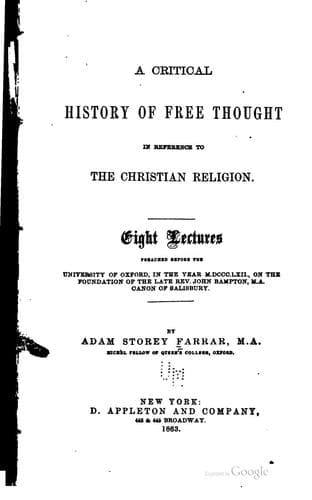
History of Free Thought in Reference to The Christian ReligionFarrar, Adam Storey
History
History of Free Thought in Reference to The Christian Religion
Farrar, Adam Storey
Free thought -- History
The moral judgment formed on the movement seen in the whole period must
vary with the phase of it viewed. The attack is not, like those of the
early unbelievers, a struggle with which the sympathies of Christians
cannot be enlisted. The darker aspects of it partake indeed of the same
character; but it embodies a better element, a nobler form of movement,
tainted perhaps with doubt, but not with disbelief; viz. the attempt of
the human mind to assert its rights in philosophy, theology, and politics;
and as the epoch closes, the great truth has made itself felt in the world
as the result of the contest, that Christianity is supreme only within its
own sphere, which it is the problem of religious philosophy to discover;
that freedom of inquiry is to be used outside the boundary, but that
speculation must expire in adoration within it.
-------------------------------------
A new crisis may be considered to commence in the fifteenth century, in
consequence of the introduction of fresh influences through the classical
revival. Yet as the two periods are connected in time, the transition is
not sudden: the old influences gradually vanish away; the new ones had
been slowly preparing before they became distinctly evident. The
intellectual and social activity of the past period had been the means of
educating the mind of Europe for the reception of the new forces which
were now beginning to operate.(300)
The fifteenth century was a remarkable period for Europe, and preeminently
for Italy. During several ages Italy had grown great by means of commerce
and religion. The crusades, which had impoverished the rest of Europe, had
enriched her; and the subjugation of the nations to the court of Rome had
made her the treasury of Europe. Material wealth permitted the
encouragement of the study of literature, which relations of commerce or
of conquest with the Greek empire had been the means of reviving.
Manuscripts were collected, and the remains of monuments of classic art
were studied. The love of antiquity gave perfection to art, and influenced
literature. The work which centuries had slowly prepared now came to
perfection. The scholastic philosophy declined; the sources of
ecclesiastical education and of the existing religion were weakened; and
by the close of the fifteenth century the tone of the age was in all
respects changed. The devotion which had expressed itself in the great
Gothic works of devotion of early ages was expiring, at least in Italy,
and art itself gradually became secular, and expressed ideas more earthly.
Public-domain text, read in full here on John Shaqi.
Reviews
Reviews
No reviews yet
Be the first to share your thoughts on this work.
Elsewhere in the archive