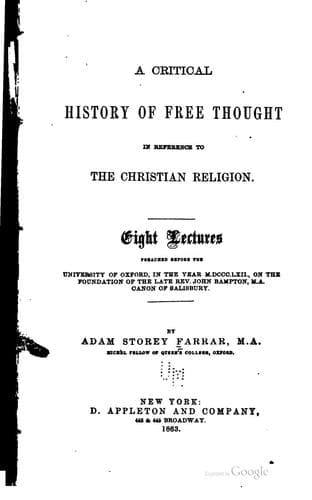
History of Free Thought in Reference to The Christian ReligionFarrar, Adam Storey
History
History of Free Thought in Reference to The Christian Religion
Farrar, Adam Storey
Free thought -- History
When such a moment of material prosperity, combined with intellectual and
social change, ensues immediately on the movement previously sketched, we
should expect to find religion subjected to re-examination, and placed in
temporary peril. The history confirms the supposition. If we regard this
crisis as embracing about two centuries and a quarter,(301) comprehending
the classical revival, the opening of a new geographical world, and the
great religious changes of the Reformation,—a period commencing with the
Renaissance, and closed by the creation of modern philosophy;—we shall
find two principal movements of unbelief for investigation, the one caused
by literature, a return to a spirit of heathenism analogous to that
already described in Julian; the second caused by philosophy, a revival of
pantheism. The first belonged especially to the close of the fifteenth
century, and had its seat for the most part in Tuscany and Rome; the
second to the sixteenth, and was represented in the university of Padua.
In both these movements, especially in the former, the open expression of
unbelief in literature is rare, though the incidental proofs of its
existence are abundant. It was a time of the dissolution of faith, not of
overt attack. Unbelief was Epicurean indifference, rather than earnestness
in destroying the old creed.
Two of the most obvious proofs that we can select for proving the
existence of a state of unbelief(302) are, the ridicule of religion
expressed in the burlesque poetry of the time, and the antichristian
sympathies of several distinguished men.
Public-domain text, read in full here on John Shaqi.
Reviews
Reviews
No reviews yet
Be the first to share your thoughts on this work.
Elsewhere in the archive
Join the Discussion
Join the discussion
Sign in to leave a comment or review.
Sign InorCreate an account