The theory of evolution, as set forth by Charles Darwin, Alfred Russel
Wallace, Sir Joseph Hooker, and others in the middle of the nineteenth
century, has clearly the closest relationship with the geographical
theory of the control exercised by environment; it has become,
indeed, its fundamental principle. Darwin accompanied the _Beagle_
surveying expedition round the world in 1831–36, and his observations
during the voyage qualified him for his life-work. Wallace’s study
of the distribution of animals brings at once to the mind his line
of demarcation between faunal regions passing through the Malay
Archipelago. Hooker was prepared for his interest in plant geography
by his voyage with Ross to the Antarctic, by his travels in northern
India (1847–51), and other journeys of wide range. Such men were
geographers though their fame does not name them so. The application of
geographical method is either essential or at least valuable in every
branch of natural science; in itself it fulfils functions which the
other natural sciences, taken individually, do not, and that is its
justification.
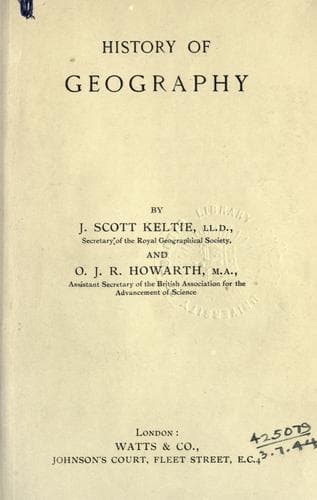
SHORT BIBLIOGRAPHY OF GEOGRAPHY
A general history of geography (mainly, however, concerned with
exploration and mapping) is Vivien de Saint-Martin’s _Histoire de la
Géographie_ (Paris, 1873); a short historical review dealing more
especially with geographical theory will be found in H. Wagner’s
_Lehrbuch der Geographie_ (Leipzig, 1900). No English parallels to
these works are to be cited, but reference may be made to H. R. Mill’s
_International Geography_ (1897) and his article on “Geography” and
E. G. Ravenstein’s on “Map” in the _Encyclopædia Britannica_ (eleventh
edition). On the earliest period see E. H. Bunbury, _History of Ancient
Geography_ (2 vols., London, 1879), and H. F. Tozer, _History of
Ancient Geography_ (1897), in the Cambridge Geographical Series; on the
“dark age” and down to 1460, C. R. Beazley, _Dawn of Modern Geography_
(3 vols., London, 1897–1906); the sixteenth century is principally
covered by the voluminous literature on Columbus, such as Sir C. R.
Markham’s _Life of Christopher Columbus_ (London, 1892), E. J. Payne’s
_History of the New World called America_ (Vol. I., Oxford, 1892); on
the seventeenth and eighteenth centuries, E. Heawood, _Geographical
Discovery in the Seventeenth and Eighteenth Centuries_ (Cambridge
Geographical Series, 1912). Some of the earlier theoretical works
have been cited in the text; a few modern works representative of the
various departments of geography may be mentioned here. Those of which
the prime purpose is description are represented by E. Reclus’s _La
Nouvelle Géographie Universelle_ (19 vols., Paris, 1876–95; there is
an English translation) and by _Stanford’s Compendium of Geography
and Travel_ (various authors.) F. Ratzel, _Anthropogeographie_
(2 vols., Stuttgart, c. 1891); Ellen C. Semple, _Influences of
Geographic Environment_ (London, 1911); E. Suess, _Das Antlitz der
Public-domain text, read in full here on John Shaqi.
Reviews
Reviews
No reviews yet
Be the first to share your thoughts on this work.
Elsewhere in the archive
Join the Discussion
Join the discussion
Sign in to leave a comment or review.
Sign InorCreate an account