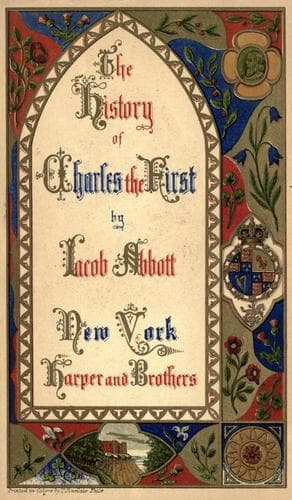
History of King Charles the First of EnglandAbbott, Jacob
History
History of King Charles the First of England
Abbott, Jacob
Charles I, King of England, 1600-1649; Great Britain -- History -- Charles I, 1625-1649; Great Britain -- Kings and rulers -- Biography
The queen rejoined her husband, and she rendered him essential service
in many ways. She had personal influence enough to raise both money and
men for his armies, and so contributed very essentially to the strength
of his party. At last she returned to the Continent again, and went to
Paris, where she was still actively employed in promoting his cause. At
one of the battles in which the king was defeated, the Parliamentary
army seized his baggage, and found among his papers his correspondence
with the queen. They very ungenerously ordered it to be published, as
the letters seemed to show a vigorous determination on the part of the
king not to yield in the contest without obtaining from the Parliament
and their adherents full and ample concessions to his claims.
[Sidenote: 1646.]
[Sidenote: The royal cause declines.]
[Sidenote: The Prince of Wales.]
As time rolled on, the strength of the royal party gradually wasted
away, while that of Parliament seemed to increase, until it became
evident that the latter would, in the end, obtain the victory. The king
retreated from place to place, followed by his foes, and growing weaker
and more discouraged after every conflict. His son, the Prince of
Wales, was then about fifteen years of age. He sent him to the western
part of the island, with directions that, if affairs should still go
against him, the boy should be taken in time out of the country, and
join his mother in Paris. The danger grew more and more imminent, and
they who had charge of the young prince sent him first to Scilly, and
then to Jersey--islands in the Channel--whence he made his escape to
Paris, and joined his mother. Fifteen years afterward he returned to
London with great pomp and parade, and was placed upon the throne by
universal acclamation.
[Sidenote: Hopeless condition of the king.]
At last the king himself, after being driven from one place of
refuge to another, retreated to Oxford and intrenched himself there.
Here he spent the winter of 1646 in extreme depression and distress.
His friends deserted him; his resources were expended; his hopes
were extinguished. He sent proposals of peace to the Parliament,
and offered, himself, to come to London, if they would grant him a
safe-conduct. In reply, they _forbade_ him to come. They would listen
to no propositions, and would make no terms. The case, they saw, was in
their own hands, and they determined on unconditional submission. They
hemmed the king in on all sides at his retreat in Oxford, and reduced
him to despair.
[Sidenote: Invasion by the Scots.]
[Sidenote: The king surrenders to the Scots.]
[Sidenote: End of the civil war.]
Public-domain text, read in full here on John Shaqi.
Reviews
Reviews
No reviews yet
Be the first to share your thoughts on this work.
Elsewhere in the archive
Join the Discussion
Join the discussion
Sign in to leave a comment or review.
Sign InorCreate an account