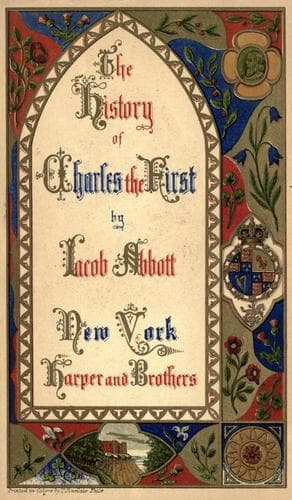
History of King Charles the First of EnglandAbbott, Jacob
History
History of King Charles the First of England
Abbott, Jacob
Charles I, King of England, 1600-1649; Great Britain -- History -- Charles I, 1625-1649; Great Britain -- Kings and rulers -- Biography
The congregation, moved by a sudden impulse of religious generosity
extremely unusual in those days, immediately sang the psalm which the
king had chosen.
[Sidenote: The king receives letters from the queen.]
While he was at Holmby the king used sometimes to go, escorted by a
guard, to certain neighboring villages where there were bowling-greens.
One day, while he was going on one of these excursions, a man, in the
dress of a laborer, appeared standing on a bridge as he passed, and
handed him a packet. The commissioners who had charge of Charles--for
some of them always attended him on these excursions--seized the man.
The packet was from the queen. The king told the commissioners that
the letter was only to ask him some question about the disposal of his
son, the young prince, who was then with her in Paris. They seemed
satisfied, but they sent the disguised messenger to London, and the
Parliament committed him to prison, and sent down word to dismiss all
Charles's own attendants, and to keep him thenceforth in more strict
confinement.
[Sidenote: The army.]
In the mean time, the Parliament, having finished the war, were ready
to disband the army. But the army did not want to be disbanded. They
would not be disbanded. The officers knew very well that if their
troops were dismissed, and they were to return to their homes as
private citizens, all their importance would be gone. There followed
long debates and negotiations between the army and the Parliament,
which ended, at last, in an open rupture. It is almost always so at the
end of a revolution. The military power is found to have become too
strong for the civil institutions of the country to control it.
[Sidenote: 1647.]
[Sidenote: Oliver Cromwell.]
[Sidenote: His plan to seize the king.]
Oliver Cromwell, who afterward became so distinguished in the days
of the Commonwealth, was at this time becoming the most influential
leader of the army. He was not the commander-in-chief in form, but
he was the great planner and manager in fact. He was a man of great
sternness and energy of character, and was always ready for the most
prompt and daring action. He conceived the design of seizing the
king's person at Holmby, so as to take him away from the control of
the Parliament, and transfer him to that of the army. This plan was
executed on the 4th of June, about two months after the king had been
taken to Holmby House. The abduction was effected in the following
manner.
[Sidenote: Cornet Joyce.]
Public-domain text, read in full here on John Shaqi.
Reviews
Reviews
No reviews yet
Be the first to share your thoughts on this work.
Elsewhere in the archive
Join the Discussion
Join the discussion
Sign in to leave a comment or review.
Sign InorCreate an account