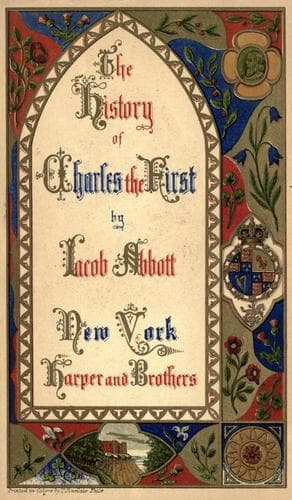
History of King Charles the First of EnglandAbbott, Jacob
History
History of King Charles the First of England
Abbott, Jacob
Charles I, King of England, 1600-1649; Great Britain -- History -- Charles I, 1625-1649; Great Britain -- Kings and rulers -- Biography
Charles was at Newcastle when they came to this decision. His mind
had been more at ease since his surrender to the Scots, and he was
accustomed to amuse himself and while away the time of his captivity by
various games. He was playing chess when the intelligence was brought
to him that he was to be delivered up to the English Parliament. It
was communicated to him in a letter. He read it, and then went on with
his game, and none of those around him could perceive by his air and
manner that the intelligence which the letter contained was any thing
extraordinary. Perhaps he was not aware of the magnitude of the change
in his condition and prospects which the communication announced.
[Sidenote: Holmby House.]
[Sidenote: Contest about forms.]
[Sidenote: Intolerance.]
There was at this time, at a town called Holmby or Holdenby, in
Northamptonshire, a beautiful palace which was known by the name of
Holmby House. King Charles's mother had purchased this palace for him
when he was the Duke of York, in the early part of his life, while
his father, King James, was on the throne, and his older brother
was the heir-apparent. It was a very stately and beautiful edifice.
The house was fitted up in a very handsome manner, and all suitable
accommodations provided for the king's reception. He had many
attendants, and every desirable convenience and luxury of living; but,
though the war was over, there was still kept up between the king and
his enemies a petty contest about forms and punctilios, which resulted
from the spirit of intolerance which characterized the age. The king
wanted his own Episcopal chaplains. The Parliament would not consent to
this, but sent him two Presbyterian chaplains. The king would not allow
them to say grace at the table, but performed this duty himself; and on
the Sabbath, when they preached in his chapel, he never would attend.
[Sidenote: The Scotch preacher.]
One singular instance of this sort of bigotry, and of the king's
presence of mind under the action of it, took place while the king
was at Newcastle. They took him one day, to the chapel in the castle
to hear a Scotch Presbyterian who was preaching to the garrison. The
Scotchman preached a long discourse pointed expressly at the king.
Those preachers prided themselves on the fearlessness with which, on
such occasions, they discharged what they called their duty. To cap the
climax of his faithfulness, the preacher gave out, at the close of the
sermon, the hymn, thus: "We will sing the fifty-first Psalm:
"'Why dost thou, tyrant, boast thyself,
Thy wicked works to praise?'"
[Sidenote: The king's presence of mind.]
As the congregation were about to commence the singing, the king cast
his eye along the page, and found in the fifty-sixth hymn one which he
thought would be more appropriate. He rose, and said, in a very audible
manner, "We will sing the fifty-_sixth_ Psalm:
"'Have mercy, Lord, on me I pray,
For men would me devour.'"
Public-domain text, read in full here on John Shaqi.
Reviews
Reviews
No reviews yet
Be the first to share your thoughts on this work.
Elsewhere in the archive
Join the Discussion
Join the discussion
Sign in to leave a comment or review.
Sign InorCreate an account