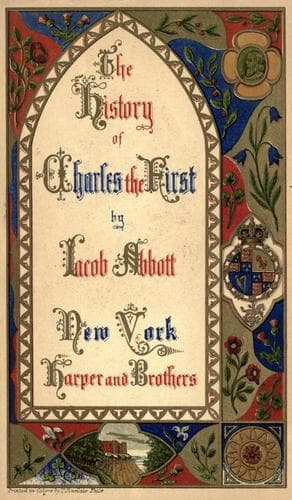
History of King Charles the First of EnglandAbbott, Jacob
History
History of King Charles the First of England
Abbott, Jacob
Charles I, King of England, 1600-1649; Great Britain -- History -- Charles I, 1625-1649; Great Britain -- Kings and rulers -- Biography
The next day the children were brought to him in the room where he was
confined. The daughter, who was called the Lady Elizabeth, was the
oldest. He directed her to tell her brother James, who was the second
son, and now absent with Charles on the Continent, that he must now,
from the time of his father's death, no longer look upon Charles as
merely his older brother, but as his sovereign, and obey him as such;
and he requested her to charge them both, from him, to love each other,
and to forgive their father's enemies.
"You will not forget this, my dear child, will you?" added the king.
The Lady Elizabeth was still very young.
"No," said she, "I will never forget it as long as I live."
He then charged her with a message to her mother, the queen, who was
also on the Continent. "Tell her," said he, "that I have loved her
faithfully all my life, and that my tender regard for her will not
cease till I cease to breathe."
Poor Elizabeth was sadly grieved at this parting interview. The king
tried to comfort her. "You must not be so afflicted for me," he said.
"It will be a very glorious death that I shall die. I die for the
laws and liberties of this land, and for maintaining the Protestant
religion. I have forgiven all my enemies, and I hope that God will
forgive them."
[Sidenote: Parting messages.]
The little son was, by title, the Duke of Gloucester. He took him on
his knees, and said, in substance, "My dear boy, they are going to cut
off your father's head." The child looked up into his father's face
very earnestly, not comprehending so strange an assertion.
"They are going to cut off my head," repeated the king, "and perhaps
they will want to make you a king; but you must not be king as long as
your brothers Charles and James live; for if you do, very likely they
will, some time or other, cut off your head." The child said, with
a very determined air, that then they should never make him king as
long as he lived. The king then gave his children some other parting
messages for several of his nearest relatives and friends, and they
were taken away.
[Sidenote: The warrant.]
In cases of capital punishment, in England and America, there must be,
after the sentence is pronounced, written authority to the sheriff, or
other proper officer, to proceed to the execution of it. This is called
the warrant, and is usually to be signed by the chief magistrate of the
state. In England the sovereign always signs the warrant of execution;
but in the case of the execution of the sovereign himself, which was a
case entirely unprecedented, the authorities were at first a little at
a loss to know what to do. The commissioners who had judged the king
concluded finally to sign it themselves. It was expressed substantially
as follows:
"At the High Court of Justice for the trying and judging of Charles
Stuart, king of England, January 29th, 1648:
Public-domain text, read in full here on John Shaqi.
Reviews
Reviews
No reviews yet
Be the first to share your thoughts on this work.
Elsewhere in the archive
Join the Discussion
Join the discussion
Sign in to leave a comment or review.
Sign InorCreate an account