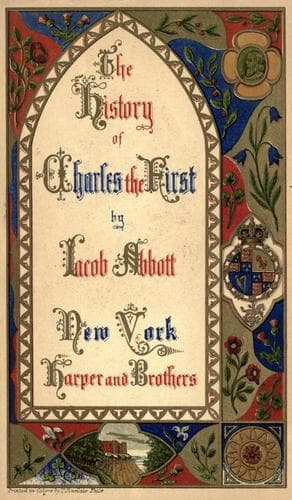
History of King Charles the First of EnglandAbbott, Jacob
History
History of King Charles the First of England
Abbott, Jacob
Charles I, King of England, 1600-1649; Great Britain -- History -- Charles I, 1625-1649; Great Britain -- Kings and rulers -- Biography
The king, in the mean time, had gone to Dover, where he awaited her
arrival. She landed at Dover on the day after sailing from Boulogne,
sea-sick and sad. The king received his bride, and with their
attendants they went by carriages to Canterbury, and on the following
day they entered London. Great preparations had been made for receiving
the king and his consort in a suitable manner; but London was, at this
time, in a state of great distress and fear on account of the plague
which had broken out there. The disease had increased during the king's
absence, and the alarm and anxiety were so great, that the rejoicings
on account of the arrival of the queen were omitted. She journeyed
quietly, therefore, to Westminster, and took up her abode at Somerset
House, which had been the residence of her predecessor. They had fitted
it up for her reception, providing for it, among other conveniences, a
Roman Catholic chapel, where she could enjoy the services of religion
in the forms to which she had been accustomed.
CHAPTER IV.
BUCKINGHAM.
[Sidenote: Charles's accession.]
Charles commenced his reign in 1625. He continued to reign about
twenty-four years. It will assist the reader to receive and retain
in mind a clear idea of the course of events during his reign, if
we regard it as divided into three periods. During the first, which
continued about four years, Charles and the Parliament were both upon
the stage, contending with each other, but not at open war. Each party
managed, and maneuvered, and struggled to gain its own ends, the
disagreement widening and deepening continually, till it ended in an
open rupture, when Charles abandoned the plan of having Parliaments at
all, and attempted to govern alone. This attempt to manage the empire
without a legislature lasted for ten years, and is the second period.
After this a Parliament was called, and it soon made itself independent
of the king, and became hostile to him, the two powers being at open
war, which constitutes the third period. Thus we have four years spent
in getting into the quarrel between the king and Parliament, ten years
in an attempt by the king to govern alone, and, finally, ten years of
war, more or less open, the king on one side, and the Parliament on the
other.
[Sidenote: Leading events of his reign.]
[Sidenote: Buckingham.]
[Sidenote: His influence over the king.]
Public-domain text, read in full here on John Shaqi.
Reviews
Reviews
No reviews yet
Be the first to share your thoughts on this work.
Join the Discussion
Join the discussion
Sign in to leave a comment or review.
Sign InorCreate an account