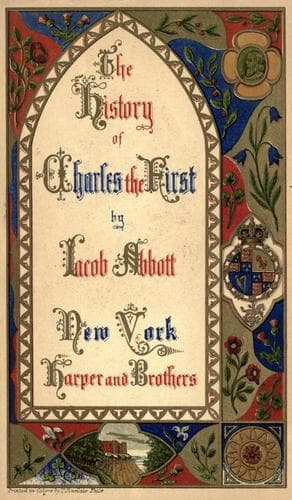
History of King Charles the First of EnglandAbbott, Jacob
History
History of King Charles the First of England
Abbott, Jacob
Charles I, King of England, 1600-1649; Great Britain -- History -- Charles I, 1625-1649; Great Britain -- Kings and rulers -- Biography
They met on the day to which they had adjourned, prepared to insist
on the speaker's putting the question. But he, immediately on the
House coming to order, said that he had received the king's command to
adjourn the House for a week, and to put no question whatever. He then
was going to leave the chair, but two of the members advanced to him
and held him in his place, while they read some resolutions which had
been prepared. There was great confusion and clamor. Some insisted that
the House was adjourned, some were determined to pass the resolutions.
The resolutions were very decided. They declared that whoever should
counsel or advise the laying of taxes not granted by Parliament, or
be an actor or instrument in collecting them, should be accounted an
innovator, and a capital enemy to the kingdom and Commonwealth. And
also, that if any person whatever should voluntarily pay such taxes,
he should be counted a capital enemy also. These resolutions were read
in the midst of great uproar. The king was informed of the facts, and
sent for the sergeant of the House--one of the highest officers--but
the members locked the door, and would not let the sergeant go. Then
the king sent one of his own officers to the House with a message. The
members kept the door locked, and would not let him in until they had
disposed of the resolutions. Then the House adjourned for a week.
[Sidenote: Members imprisoned.]
The next day, several of the leading members who were supposed to have
been active in these proceedings were summoned to appear before the
council. They refused to answer out of Parliament for what was said
and done by them in Parliament. The council sent them to prison in the
Tower.
[Sidenote: Dissolution of Parliament.]
[Sidenote: The king in the House of Lords.]
[Sidenote: The king's speech on dissolving Parliament.]
The week passed away, and the time for the reassembling of the
Houses arrived. It had been known, during the week, that the king
had determined on dissolving Parliament. It is usual, in dissolving
a Parliament, for the sovereign not to appear in person, but to send
his message of dissolution by some person commissioned to deliver it.
This is called dissolving the House by commission. The dissolution
is always declared in the House of Lords, the Commons being summoned
to attend. In this case, however, the king attended in person. He was
dressed magnificently in his royal robes, and wore his crown. He would
not deign, however, to send for the Commons. He entered the House of
Peers, and took his seat upon the throne. Several of the Commons,
however, came in of their own accord, and stood below the bar, at the
usual place assigned them. The king then rose and read the following
speech. The antiquity of the language gives it an air of quaintness now
which it did not possess then.
Public-domain text, read in full here on John Shaqi.
Reviews
Reviews
No reviews yet
Be the first to share your thoughts on this work.
Elsewhere in the archive
Join the Discussion
Join the discussion
Sign in to leave a comment or review.
Sign InorCreate an account