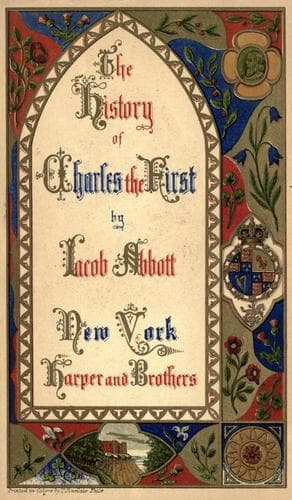
History of King Charles the First of EnglandAbbott, Jacob
History
History of King Charles the First of England
Abbott, Jacob
Charles I, King of England, 1600-1649; Great Britain -- History -- Charles I, 1625-1649; Great Britain -- Kings and rulers -- Biography
"My Lords,--I never came here upon so unpleasant an occasion, it being
the Dissolution of a Parliament. Therefore Men may have some cause
to wonder why I should not rather chuse to do this by Commission,
it being a general Maxim of Kings to leave harsh Commands to their
Ministers, Themselves only executing pleasing things. Yet considering
that Justice as well consists in Reward and Praise of Virtue as
Punishing of Vice, I thought it necessary to come here to-day,
and to declare to you and all the World, that it was merely the
undutiful and seditious Carriage in the Lower House that hath made the
Dissolution of this Parliament. And you, my Lords, are so far from
being any Causers of it, that I take as much comfort in your dutiful
Demeanour, as I am justly distasted with their Proceedings. Yet, to
avoid their Mistakings, let me tell you, that it is so far from me to
adjudge all the House alike guilty, that I know there are many there
as dutiful subjects as any in the World; it being but some few Vipers
among them that did cast this Mist of Undutifulness over most of their
Eyes. Yet to say Truth, there was a good Number there that could not
be infected with this Contagion.
"To conclude, As those Vipers must look for their Reward of
Punishment, so you, my Lords, may justly expect from me that Favor and
Protection that a good King oweth to his loving and faithful Nobility.
And now, my Lord Keeper, do what I have commanded you."
Then the lord keeper pronounced the Parliament dissolved. The lord
keeper was the keeper of the great seal, one of the highest officers of
the crown.
[Sidenote: The king resolves to do without Parliaments.]
Of course this affair produced a fever of excitement against the king
throughout the whole realm. This excitement was kept up and increased
by the trials of the members of Parliament who had been imprisoned.
The courts decided against them, and they were sentenced to long
imprisonment and to heavy fines. The king now determined to do without
Parliaments entirely; and, of course, he had to raise money by his
royal prerogative altogether, as he had done, in fact, before, a great
deal, during the intervals between the successive Parliaments. It will
not be very entertaining, but it will be very useful to the reader to
peruse carefully some account of the principal methods resorted to
by the king. In order, however, to diminish the necessity for money
as much as possible, the king prepared to make peace with France and
Spain; and as they, as well as England, were exhausted with the wars,
this was readily effected.
[Sidenote: 1630.]
[Sidenote: Forced loans.]
Public-domain text, read in full here on John Shaqi.
Reviews
Reviews
No reviews yet
Be the first to share your thoughts on this work.
Elsewhere in the archive
Join the Discussion
Join the discussion
Sign in to leave a comment or review.
Sign InorCreate an account