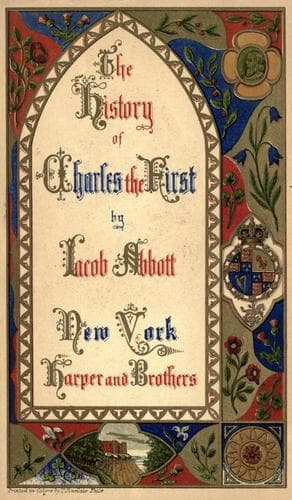
History of King Charles the First of EnglandAbbott, Jacob
History
History of King Charles the First of England
Abbott, Jacob
Charles I, King of England, 1600-1649; Great Britain -- History -- Charles I, 1625-1649; Great Britain -- Kings and rulers -- Biography
The king, accordingly, in 1633, began to make preparations for a royal
progress into Scotland. He first issued a proclamation requiring a
proper supply of provisions to be collected at the several points of
his proposed route, and specified the route, and the length of stay
which he should make in each place. He set out on the 13th of May with
a splendid retinue. He stopped at the seats of several of the nobility
on the way, to enjoy the hospitalities and entertainments which they
had prepared for him. He proceeded so slowly that it was a month before
he reached the frontier. Here all his English servants and retinue
retired from their posts, and their places were supplied by Scotchmen
who had been previously appointed, and who were awaiting his arrival.
He entered Edinburgh with great pomp and parade, all Scotland flocking,
to the capital to witness the festivities. The coronation took place
three days afterward. He met the Scotch Parliament, and, for form's
sake, took a part in the proceedings, so as actually to exercise his
royal authority as King of Scotland. This being over, he was conducted
in great state back to Berwick, which is on the frontier, and thence
he returned by rapid journeys to London.
[Sidenote: Increasing discontent.]
The king dissolved his last Parliament in 1629. He had now been
endeavoring for four or five years to govern alone. He succeeded
tolerably well, so far as external appearances indicated, up to
this time. There was, however, beneath the surface, a deep-seated
discontent, which was constantly widening and extending, and, soon
after the return of the king from Scotland, real difficulties gradually
arose, by which he was, in the end, compelled to call a Parliament
again. What these difficulties were will be explained in the subsequent
chapters.
CHAPTER VI.
ARCHBISHOP LAUD.
[Sidenote: Archbishop Laud.]
In getting so deeply involved in difficulties with his people, King
Charles did not act alone. He had, as we have already explained, a
great deal of help. There were many men of intelligence and rank who
entertained the same opinions that he did, or who were, at least,
willing to adopt them for the sake of office and power. These men he
drew around him. He gave them office and power, and they joined him
in the efforts he made to defend and enlarge the royal prerogative,
and to carry on the government by the exercise of it. One of the most
prominent and distinguished of these men was Laud.
[Sidenote: The Church.]
[Sidenote: 1633-6.]
[Sidenote: System of the English Church.]
[Sidenote: The Archbishop of Canterbury.]
Public-domain text, read in full here on John Shaqi.
Reviews
Reviews
No reviews yet
Be the first to share your thoughts on this work.
Elsewhere in the archive
Join the Discussion
Join the discussion
Sign in to leave a comment or review.
Sign InorCreate an account