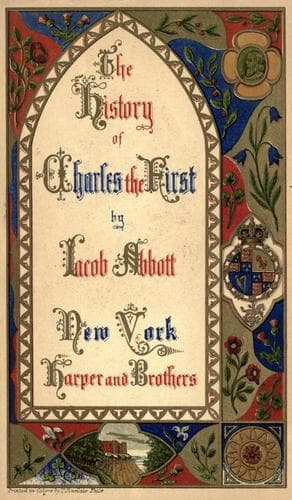
History of King Charles the First of EnglandAbbott, Jacob
History
History of King Charles the First of England
Abbott, Jacob
Charles I, King of England, 1600-1649; Great Britain -- History -- Charles I, 1625-1649; Great Britain -- Kings and rulers -- Biography
[Sidenote: His business capacity.]
King Charles had made him so. He had observed that Laud, who had been
advanced to some high stations in the Church by his father, King James,
was desirous to enlarge and strengthen the powers and prerogatives
of the Church, just as he himself was endeavoring to do in respect
to those of the throne. He accordingly promoted him from one post of
influence and honor to another, until he made him at last Archbishop
of Canterbury. Thus he was placed upon the summit of ecclesiastical
grandeur and power.
[Sidenote: Laud's character.]
[Sidenote: Episcopacy in England and the United States.]
He commenced his work, however, of strengthening and aggrandizing the
Church, before he was appointed to this high office. He was Bishop of
London for many years, which is a post, in some respects, second only
to that of Archbishop of Canterbury. While in this station, he was
appointed by the king to many high civil offices. He had great capacity
for the transaction of business, and for the fulfillment of high
trusts, whether of Church or state. He was a man of great integrity
and moral worth. He was stern and severe in manners, but learned and
accomplished. His whole soul was bent on what he undoubtedly considered
the great duty of his life, supporting and confirming the authority
of the king, and the power and influence of English Episcopacy.
Notwithstanding his high qualifications, however, many persons were
jealous of the influence which he possessed with the king, and murmured
against the appointment of a churchman to such high offices of state.
There was another source of hostility to Laud. There was a large
part of the people of England who were against the Church of England
altogether. They did not like a system in which all power and influence
came, as it were, from above downward. The king made the noblemen, the
noblemen made the bishops, the bishops made the clergy, and the clergy
ruled their flocks; the flocks themselves having nothing to say or do
but to submit. It is very different with Episcopacy in this country.
The people here choose the clergy, and the clergy choose the bishops,
so that power in the Church, as in every thing else here, goes from
below upward. The two systems, when at rest, look very similar in
the two countries; but when in action, the current of life flows in
contrary directions, making the two diametrically opposite to each
other in spirit and power. In England, Episcopacy is an engine by which
the people are ecclesiastically governed. Here, it is the machinery by
which they govern. Whatever the forms are, the fact must be that the
people govern here.
[Sidenote: Opposition to the Established Church.]
[Sidenote: The Puritans.]
Public-domain text, read in full here on John Shaqi.
Reviews
Reviews
No reviews yet
Be the first to share your thoughts on this work.
Elsewhere in the archive
Join the Discussion
Join the discussion
Sign in to leave a comment or review.
Sign InorCreate an account