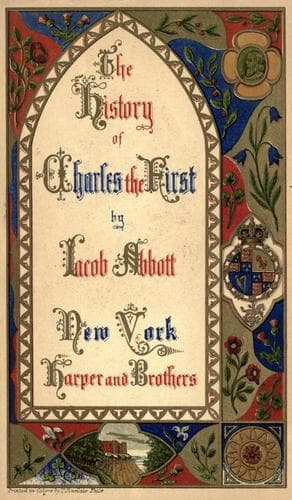
History of King Charles the First of EnglandAbbott, Jacob
History
History of King Charles the First of England
Abbott, Jacob
Charles I, King of England, 1600-1649; Great Britain -- History -- Charles I, 1625-1649; Great Britain -- Kings and rulers -- Biography
Sir Thomas Wentworth was a member of Parliament in those days, and
in the contests between the king and the Parliament he took the side
of Parliament. Charles used to maintain that _his_ power alone was
hereditary and sovereign; that the Parliament was his council; and
that they had no powers or privileges except what he himself or his
ancestors had granted and allowed them. Wentworth took very strong
ground against this. He urged Parliament to maintain that their
rights and privileges were inherent and hereditary as well as those
of the king; that such powers as they possessed were their own, and
were entirely independent of royal grant or permission; and that the
king could no more encroach upon the privileges of Parliament, than
Parliament upon the prerogatives of the king. This was in the beginning
of the difficulties between the king and the Commons.
[Sidenote: 1628.]
[Sidenote: The leaders removed.]
[Sidenote: The opposition still continues.]
It will, perhaps, be recollected by the reader, that one of the plans
which Charles adopted to weaken the opposition to him in Parliament
was by appointing six of the leaders of this opposition to the office
of sheriff in their several counties. And as the general theory of
all monarchies is that the subjects are bound to obey and serve the
king, these men were obliged to leave their seats in Parliament and go
home, to serve as sheriffs. Charles and his council supposed that the
rest would be more quiet and submissive when the leaders of the party
opposed to him were taken away. But the effect was the reverse. The
Commons were incensed at such a mode of interfering with their action,
and became more hostile to the royal power than ever.
[Sidenote: Wentworth imprisoned.]
[Sidenote: His return to Parliament.]
Wentworth himself, too, was made more determined in his opposition by
this treatment. A short time after this, the king's plan of a forced
loan was adopted, which has already been described; that is, a sum
of money was assessed in the manner of a tax upon all the people of
the kingdom, and each man was required to lend his proportion to the
government. The king admitted that he had no right to make people
_give_ money without the action of Parliament, but claimed the right to
require them to _lend_ it. As Sir Thomas Wentworth was a man of large
fortune, his share of the loan was considerable. He absolutely refused
to pay it. The king had him brought before a court which was entirely
under his influence, and he was condemned to be imprisoned. Knowing,
however, that this claim on the part of the king was very doubtful,
they mitigated his confinement by allowing him first a range of two
miles around his place of confinement, and afterward they released him
entirely.
Public-domain text, read in full here on John Shaqi.
Reviews
Reviews
No reviews yet
Be the first to share your thoughts on this work.
Elsewhere in the archive
Join the Discussion
Join the discussion
Sign in to leave a comment or review.
Sign InorCreate an account