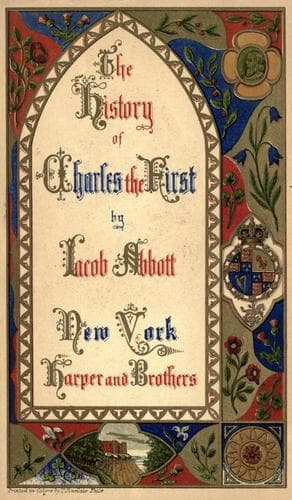
History of King Charles the First of England — John Shaqi
History of King Charles the First of EnglandAbbott, Jacob
History
History of King Charles the First of England
Abbott, Jacob
Charles I, King of England, 1600-1649; Great Britain -- History -- Charles I, 1625-1649; Great Britain -- Kings and rulers -- Biography
Little Charles was four years old when he reached Windsor Castle.
They celebrated his arrival with great rejoicings, and a day or two
afterward they invested him with the title of Duke of York, a still
higher distinction than he had before attained. Soon after this, when
he was perhaps five or six years of age, a gentleman was appointed to
take the charge of his education. His health gradually improved, though
he still continued helpless and feeble. It was a long time before he
could walk, on account of some malformation of his limbs. He learned to
talk, too, very late and very slowly. Besides the general feebleness of
his constitution, which kept him back in all these things, there was an
impediment in his speech, which affected him very much in childhood,
and which, in fact, never entirely disappeared.
[Sidenote: His progress in learning.]
As soon, however, as he commenced his studies under his new tutor, he
made much greater progress than had been expected. It was soon observed
that the feebleness which had attached to him pertained more to the
body than to the mind. He advanced with considerable rapidity in his
learning. His progress was, in fact, in some degree, promoted by his
bodily infirmities, which kept him from playing with the other boys of
the court, and led him to like to be still, and to retire from scenes
of sport and pleasure which he could not share.
The same cause operated to make him not agreeable as a companion, and
he was not a favorite among those around him. They called him _Baby_
Charley. His temper seemed to be in some sense soured by the feeling
of his inferiority, and by the jealousy he would naturally experience
in finding himself, the son of a king, so outstripped in athletic
sports by those whom he regarded as his inferiors in rank and station.
[Sidenote: 1616.]
[Sidenote: Charles improves in health.]
[Sidenote: Death of his brother.]
The lapse of a few years, however, after this time, made a total change
in Charles's position and prospects. His health improved, and his
constitution began to be confirmed and established. When he was about
twelve years of age, too, his brother Henry died. This circumstance
made an entire change in all his prospects of life. The eyes of the
whole kingdom, and, in fact, of all Europe, were now upon him as the
future sovereign of England. His sister Elizabeth, who was a few
years older than himself, was, about this time, married to a German
prince, with great pomp and ceremony, young Charles acting the part of
brideman. In consequence of his new position as heir-apparent to the
throne, he was advanced to new honors, and had new titles conferred
upon him, until at last, when he was sixteen years of age, he was made
Prince of Wales, and certain revenues were appropriated to support a
court for him, that he might be surrounded with external circumstances
and insignia of rank and power, corresponding with his prospective
greatness.
[Sidenote: 1618.]
Public-domain text, read in full here on John Shaqi.
Reviews
Reviews
No reviews yet
Be the first to share your thoughts on this work.
Join the Discussion
Join the discussion
Sign in to leave a comment or review.
Sign InorCreate an account