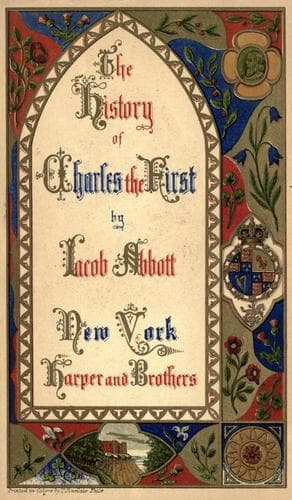
History of King Charles the First of EnglandAbbott, Jacob
History
History of King Charles the First of England
Abbott, Jacob
Charles I, King of England, 1600-1649; Great Britain -- History -- Charles I, 1625-1649; Great Britain -- Kings and rulers -- Biography
This advice was followed. A temporary treaty was made with the rebels,
although making a treaty with rebels is perhaps the most humiliating
thing that a hereditary sovereign is ever compelled to do. The Earl
of Strafford was, however, entirely opposed to this policy. He urged
the king most earnestly not to give up the contest without a more
decisive struggle. He represented to him the danger of beginning to
yield to the torrent which he now began to see would overwhelm them
all if it was allowed to have its way. He tried to persuade the king
that the Scots might yet be driven back, and that it would be possible
to get along without a Parliament. He dreaded a Parliament. The king,
however, and his other advisers, thought that they must yield a little
to the storm. Strafford then wanted to be allowed to return to his
post in Ireland, where he thought that he should probably be safe from
the terrible enmity which he must have known that he had awakened in
England, and which he thought a Parliament would concentrate and bring
upon his devoted head. But the king would not consent to this. He
assured Strafford that if a Parliament should assemble, he would take
care that they should not hurt a hair of his head. Unfortunate monarch!
How little he foresaw that that very Parliament, from whose violence he
thus promised to defend his favorite servant so completely as to insure
him from the slightest injury, would begin by taking off his favorite's
head, and end with taking off his own!
CHAPTER VIII.
DOWNFALL OF STRAFFORD AND LAUD.
[Sidenote: Opening of the new Parliament.]
The Parliament assembled in November, 1640. The king proceeded to
London to meet them. He left Strafford in command of the army at York.
Active hostilities had been suspended, as a sort of temporary truce
had been concluded with the Scots, to prepare the way for a final
treaty. Strafford had been entirely opposed to this, being still full
of energy and courage. The king, however, began to feel alarmed. He
went to London to meet the Parliament which he had summoned, but he was
prepared to meet them in a very different spirit from that which he
had manifested on former occasions. He even gave up all the external
circumstances of pomp and parade with which the opening of Parliament
had usually been attended. He had been accustomed to go to the House of
Lords in state, with a numerous retinue and great parade. Now he was
conveyed from his palace along the river in a barge, in a quiet and
unostentatious manner.
[Sidenote: The king's speech.]
His opening speech, too, was moderate and conciliatory. In a word, it
was pretty evident to the Commons that the proud and haughty spirit of
their royal master was beginning to be pretty effectually humbled.
[Sidenote: Attacks on Strafford and Laud.]
[Sidenote: Speeches against them.]
Public-domain text, read in full here on John Shaqi.
Reviews
Reviews
No reviews yet
Be the first to share your thoughts on this work.
Elsewhere in the archive
Join the Discussion
Join the discussion
Sign in to leave a comment or review.
Sign InorCreate an account