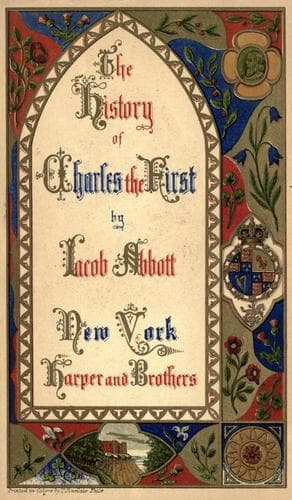
History of King Charles the First of EnglandAbbott, Jacob
History
History of King Charles the First of England
Abbott, Jacob
Charles I, King of England, 1600-1649; Great Britain -- History -- Charles I, 1625-1649; Great Britain -- Kings and rulers -- Biography
He went on, therefore, till the close of 1641, yielding slowly and
reluctantly, and with many struggles, but still all the time yielding,
to the resistless current which bore him along. At last he resolved
to yield no longer. After retreating so long, he determined suddenly
and desperately to face about and attack his enemies. The whole world
looked on with astonishment at such a sudden change of his policy.
[Sidenote: The king determines to change his policy.]
The measure which he resorted to was this. He determined to select a
number of the most efficient and prominent men in Parliament, who had
been leaders in the proceedings against him, and demand their arrest,
imprisonment, and trial, on a charge of high treason. The king was
influenced to do this partly by the advice of the queen, and of the
ladies of the court, and other persons who did not understand how deep
and strong the torrent was which they thus urged him to attempt to
stem. They thought that if he would show a little courage and energy
in facing these men, they would yield in their turn, and that their
boldness and success was owing, in a great measure, to the king's want
of spirit in resisting them. "Strike boldly at them," said they; "seize
the leaders; have them tried, and condemned, and executed. Threaten the
rest with the same fate; and follow up these measures with energetic
and decisive action, and you will soon make a change in the aspect of
affairs."
[Sidenote: 1642.]
[Sidenote: The king sends his officers to the House.]
The king adopted this policy, and he did make a change in the aspect
of affairs, but not such a change as his advisers had anticipated.
The Commons were thrown suddenly into a state of astonishment one day
by the appearance of a king's officer in the House, who rose and read
articles of a charge of treason against five of the most influential
and popular members. The officer asked that a committee should be
appointed to hear the evidence against them which the king was
preparing. The Commons, on hearing this, immediately voted, that if any
person should attempt even to seize the papers of the persons accused,
it should be lawful for them to resist such an attempt by every means
in their power.
The next day another officer appeared at the bar of the House of
Commons, and spoke as follows. "I am commanded by the king's majesty,
my master, upon my allegiance, that I should come to the House of
Commons, and require of Mr. Speaker five gentlemen, members of the
House of Commons; and those gentlemen being delivered, I am commanded
to arrest them in his majesty's name, on a charge of high treason." The
Commons, on hearing this demand, voted that they would take it into
consideration!
[Sidenote: The king goes to the House himself.]
[Sidenote: The king's speech in the House.]
Public-domain text, read in full here on John Shaqi.
Reviews
Reviews
No reviews yet
Be the first to share your thoughts on this work.
Elsewhere in the archive
Join the Discussion
Join the discussion
Sign in to leave a comment or review.
Sign InorCreate an account