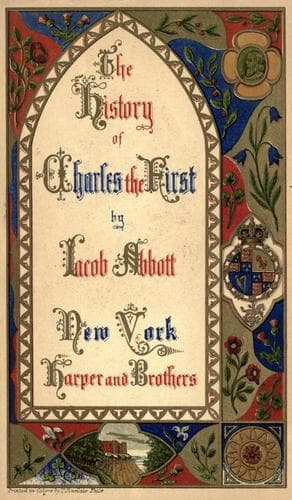
History of King Charles the First of EnglandAbbott, Jacob
History
History of King Charles the First of England
Abbott, Jacob
Charles I, King of England, 1600-1649; Great Britain -- History -- Charles I, 1625-1649; Great Britain -- Kings and rulers -- Biography
The king's coming thus into the House of Commons, and demanding in
person that they should act according to his instructions, was a very
extraordinary circumstance--perhaps unparalleled in English history. It
produced the greatest excitement. When he had finished his address, he
turned to the speaker and asked him where those men were. He had his
guard ready at the door to seize them. It is difficult for us, in this
country, to understand fully to how severe a test this sudden question
put the presence of mind and courage of the speaker; for we can not
realize the profound and awful deference which was felt in those days
for the command of a king. The speaker gained great applause for the
manner in which he stood the trial. He fell upon his knees before the
great potentate who had addressed him, and said, "I have, sir, neither
eyes to see, nor tongue to speak, in this place, but as the House is
pleased to direct me, whose servant I am. And I humbly ask pardon that
I can not give any other answer to what your majesty is pleased to
demand of me."
[Sidenote: Results of the king's rashness.]
The House was immediately in a state of great excitement and confusion.
They called out "_Privilege! privilege!_" meaning that their
privileges were violated. They immediately adjourned. News of the
affair spread every where with the greatest rapidity, and produced
universal and intense excitement. The king's friends were astonished at
such an act of rashness and folly, which, it is said, only _one_ of the
king's advisers knew any thing about, and he immediately fled. The five
members accused went that night into the city of London, and called on
the government and people of London to protect them. The people armed
themselves. In a word, the king found at night that he had raised a
very threatening and terrible storm.
[Sidenote: Committee of the Commons.]
The Commons met the next morning, but did not attempt to transact
business. They simply voted that it was useless for them to proceed
with their deliberations, while exposed to such violations of their
rights. They appointed a committee of twenty-four to inquire into
and report the circumstances of the king's intrusion into their
councils, and to consider how this breach of their privileges could be
repaired. They ordered this committee to sit in the city of London,
where they might hope to be safe from such interruptions, and then the
House adjourned for a week, to await the result of the committee's
deliberations.
The committee went to London. In the mean time, news went all over the
kingdom that the House of Commons had been compelled to suspend its
sittings on account of an illegal and unwarrantable interference with
their proceedings on the part of the king. The king was alarmed; but
those who had advised him to adopt this measure told him that he must
not falter now. He must persevere and carry his point, or all would be
lost.
[Sidenote: The king goes to London.]
[Sidenote: Cries of the people.]
Public-domain text, read in full here on John Shaqi.
Reviews
Reviews
No reviews yet
Be the first to share your thoughts on this work.
Elsewhere in the archive
Join the Discussion
Join the discussion
Sign in to leave a comment or review.
Sign InorCreate an account