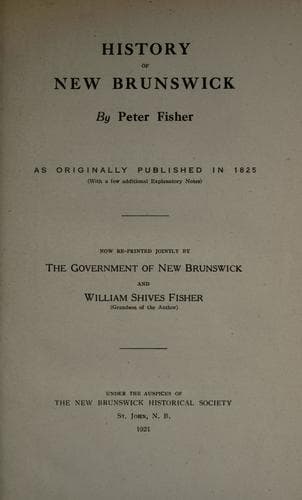
New Brunswick -- Description and travel; New Brunswick -- History
The war may be said to have ended with the surrender of the army under
Lord Cornwallis, at Yorktown, on October 19, 1781, and little attempt
at recruiting was made subsequently; consequently the regiments
continued to dwindle until, at the evacuation of New-York, two years
later, they were not more than one-third of their original strength.
The New Jersey Volunteers, a year after their arrival in New-Brunswick,
were mustered by Thomas Knox, under the supervision of Col. Edward
Winslow. The return is dated at Fort Howe, September 25, 1784, and the
number of those then on their lands, and for whom the Royal bounty of
provisions was furnished, was as follows:--
Men Women Children Servants Total
Over 10 Under 10
1st New Jersey Vols. 158 57 57 39 9 320
2nd " " 132 45 44 38 14 273
3rd " " 173 64 47 42 6 332
--- --- --- --- --- ---
Total 463 166 148 119 29 925
The commander of the 3rd Battalion, Lieut.-Col. VanBuskirk, did not
come with his men to the River St. John but settled in Shelburne, where
he was the first mayor of the town. The troops for St. John sailed in
charge of Lieut.-Col. Richard Hewlett as senior officer, with
Lieut.-Col. Gabriel DeVeber second in command. They left New-York on
September 15, 1783, and arrived safely in St. John harbour on the 26th,
with the exception of the transports "Martha" and "Esther." The former
was wrecked near Yarmouth and more than half of her passengers were
lost. The "Esther," in which VanBuskirk's battalion had embarked, got
off her course in the fog and narrowly escaped destruction, arriving a
day or two behind her sister ships.
As Peter Fisher was born on Staten Island, on June 9, 1782, he was a
very young Loyalist indeed at the time of his arrival in Blue-nose
Land, being, in point of fact, less than sixteen months old.
Sir Guy Carleton's orders were that the several corps should proceed at
once to the places allotted for their settlement, directions having
been given to Captain John Colville, assistant agent of all small craft
at the St. John River, to afford every assistance in his power to the
corps in getting to their destinations. Three days after their arrival
the troops disembarked and encamped above the Falls, near the Indian
House. Hewlett wrote Sir Guy Carleton that he feared the want of small
craft would greatly delay their progress. He writes again on the 13th
October, 1783, that the troops had been disbanded and were getting up
the river as fast as the scarcity of small craft for conveying them
would admit.
Public-domain text, read in full here on John Shaqi.
Reviews
Reviews
No reviews yet
Be the first to share your thoughts on this work.
Elsewhere in the archive
Join the Discussion
Join the discussion
Sign in to leave a comment or review.
Sign InorCreate an account