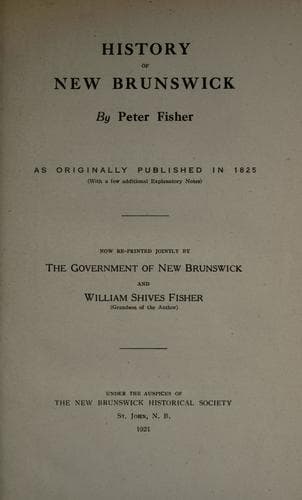
New Brunswick -- Description and travel; New Brunswick -- History
The genius of these people differ greatly from Europeans--the human
mind in new countries left to itself exerts its full energy; hence in
America where man has in most cases to look to himself for the supply
of his wants, his mind expands, and possesses resources within itself
unknown to the inhabitants of old settled countries, or populous
cities. In New-Brunswick, a man with his axe and a few other simple
tools, provides himself with a house and most of his implements of
husbandry,--and while a European would consider himself as an outcast,
he feels perfectly at home in the depth of the forest. In new countries
likewise the mind acquires those ideas of self-importance and
independence so peculier to Americans. For the man who spends the
greater part of his time alone in the forest, as free as the beasts
that range it without controul, his wants but simple and those supplied
from day to day by his own exertions, acquires totally different habits
of acting and thinking, from the great mass of the people in crowded
cities, who finding themselves pressed on all sides, and depending on
others from day to day for precarious support, are confirmed in habits
of dependence.
Hence the inhabitants of this Province are men who possess much native
freedom in their manners. This, from their veneration to their King
makes them faithful subjects and good citizens, not blindly passive,
but from affection adhering to that Government under which they drew
their first breath and under which they have been reared.
In noticing the state of religion in this Province, it may not be amiss
to observe that the old inhabitants who came originally from
New-England, where the genius of their church government was
republican, were generally Calvinistic in their modes and doctrine;
while the loyalists and others who came to the country in 1783, were
generally Churchmen, Quakers, or Methodists. The Emigrants who have
come since that period include all the above denominations.
The Church of England is in a flourishing state in this Province; there
are nineteen Clergymen belonging to the establishment who are under the
jurisdiction of the Bishop of Nova-Scotia. Many of them have handsome
churches with numerous congregations. Two of them are employed as
Itinerants for the vacant districts of the Province, and several of the
others serve two or more Parishes--An Ecclesiastical Commissary has the
superintendence of the whole.
The Catholics have a few Chapels and appear to be on the increase.
Their congregations are chiefly composed of Emigrant Irish, French, and
Indians.--There are six Clergymen in the Province, some of whom are
settled and others are employed as Missionaries among the scattered
French and Indians.
Public-domain text, read in full here on John Shaqi.
Reviews
Reviews
No reviews yet
Be the first to share your thoughts on this work.
Join the Discussion
Join the discussion
Sign in to leave a comment or review.
Sign InorCreate an account