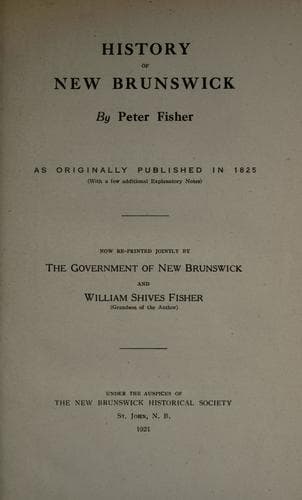
New Brunswick -- Description and travel; New Brunswick -- History
About nine miles above Fredericton the river suddenly widens and
receives the Madam-Keswick. Here is a group of fertile islands, some of
which are over a mile in length, and nearly as broad. At Fredericton
the river is about three quarters of a mile wide, and flows with a
beautiful unbroken current to the falls near the City of Saint John.--A
number of fine Islands are scattered in different parts of its bed.
These Islands are composed of rich alluvial soil, and produce large
crops of grass and grain. Being formed by the washings of the river,
they are like garden spots scattered through the country. About nine
miles from St. John the river widens into a bay nearly six miles long
and three wide. The river Kennebeckasis falls into this bay. At the
foot of the bay it suddenly contracts, and winds through a crooked
passage called the narrows, and again opens and forms a small bay
directly above the falls. Here the current is again broken by a bed of
rocks, and suddenly contracted by the near approach of the banks which
appear to have been formerly united and forced asunder by some
convulsion of nature. From the appearance of the rocks on each side it
is probable that the water having been pent up in the small bay just
noticed, have in their efforts to escape undermined the land and rocks
at this place, and forced a subterraneous passage, which by wearing,
aided by some violent concussion, has caused the rocks to fall in, when
the earth being washed away by the rapidity of the current, has left
the present passage open, and that the split-rock and the bed of the
channel is part of the former overhanging rocks.
For that the bed of the channel consists of cragged rocks of various
shapes and sizes, is evident from the whirlpools and eddies at that
place. These falls make a tremendous roaring at certain periods. After
passing the falls, it forms the harbour of St. John, and falls into the
Bay of Fundy in lat. 45 deg. 20' N.
The spring tides at St. John rise from twenty-four to twenty-eight
feet. The body of the river is seventeen and a half feet above low
water mark. When the tide has flowed twelve feet, the falls are smooth
and passable from fifteen to twenty minutes. They are level three and a
half hours on the flood, and two and a half on the ebb, and passable
four times in twenty-four hours. Above the falls the tides rise four
feet. At Maugerville, seventy miles up the river, they rise from one to
two feet; at Fredericton from six to ten inches, and are perceivable
nine miles above that place, varying according to the phases of the
moon. In the spring, the river, swoln with rains and the melting of the
snow and ice, rises higher than the tides, which prevents vessels from
ascending the falls for some weeks.
RIVER MIRAMICHI.
Public-domain text, read in full here on John Shaqi.
Reviews
Reviews
No reviews yet
Be the first to share your thoughts on this work.
Join the Discussion
Join the discussion
Sign in to leave a comment or review.
Sign InorCreate an account