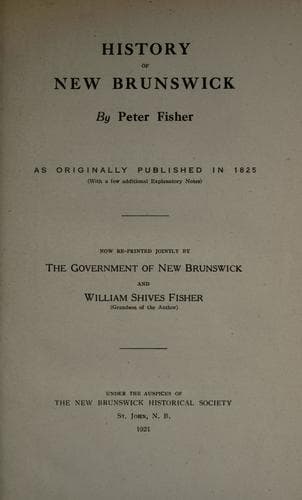
New Brunswick -- Description and travel; New Brunswick -- History
From this period the Province slowly improved in Agriculture, Ship
Building, and the exportation of Masts, Spars, &c. to Great-Britain,
and Fish, Staves, Shingles, Hoop Poles, and sawed Lumber to the
West-Indies. Receiving in return coarse Woollens and other articles
from England; and Rum, Sugar, Molasses, and other produce from the
West-Indies.--a Town was built at the mouth of the River Saint John,
and another at St. Ann's Point, called Fredericton, where part of two
Regiments were stationed till the French revolution.--Barracks and
other public works were erected in different places, and the upper part
of the Country settled by establishing two military posts in the
interior, one at the Presqu-Isle, eighty miles above Fredericton, and
another at the Grand Falls, fifty-two miles farther up. But the
difficulties to which the first settlers were exposed continued for a
long time almost insurmountable. Having been reared in a pleasant
Country, abounding in all the comforts of life, they found themselves
suddenly transplanted to a wilderness with a rigorous climate, devoid
of almost every thing that could make life tolerable.--On their arrival
they found a few hovels where Saint John is now built, the adjacent
country exhibiting a most desolate aspect; which was peculiarly
discouraging to people who had just left their homes in the beautiful
and cultivated parts of the United States. Up the River Saint John the
country appeared better, and a few cultivated spots were found occupied
by old settlers. At St. Ann's, where Fredericton was afterwards built,
a few scattered huts of French were found; the country all around being
a continued wilderness--uninhabited and untrodden, except by the savage
and wild animals; and scarcely had these firm friends of their country
began to construct their cabins, when they were surprised by the rigors
of an untried climate: their habitations being enveloped in snow before
they were tenantable. The climate at that period (from what cause has
not yet been satisfactorily ascertained) being far more severe than at
present. They were frequently put to the greatest straits for food and
clothing to preserve existence; a few roots were all that tender
mothers could at times procure to allay the importunate calls of their
children for food.--Sir GUY CARLETON had ordered them provisions for
the first year at the expense of Government; but as the country was not
much cultivated at that time, food could scarcely be procured on any
terms. Frequently had those settlers to go from fifty to one hundred
miles with hand sleds or toboggans through wild woods or on the ice to
procure a precarious supply for their famishing families. The
privations and sufferings of some of those people almost exceed belief.
The want of food and clothing in a wild, cold country, was not easily
dispensed with or soon remedied. Frequently in the piercing cold of
winter a part of the family had to remain up during the night to keep
Public-domain text, read in full here on John Shaqi.
Reviews
Reviews
No reviews yet
Be the first to share your thoughts on this work.
Join the Discussion
Join the discussion
Sign in to leave a comment or review.
Sign InorCreate an account