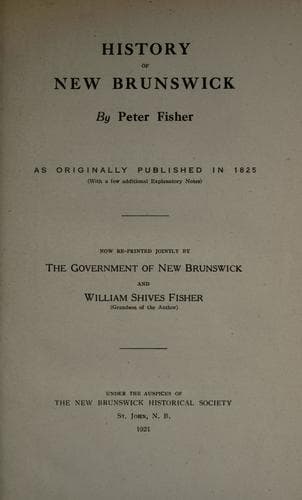
New Brunswick -- Description and travel; New Brunswick -- History
CHAPTER II.
GENERAL DESCRIPTION.
_Situation. Extent. Boundaries. Face of the Country. Soil, Animals.
Mineral and Vegetable Productions. Inhabitants, Religion, and
Government._
New-Brunswick is situated between the forty-fifth and forty-ninth
degrees of North latitude, and between the sixty-fourth and
sixty-eighth degrees of West longitude. It is nearly 200 miles in
length, and 180 in breadth, containing about twenty-two thousand square
miles of land and water. It is bounded on the North by the river St.
Lawrence and Canada, on the West by the State of Maine, on the South
and Southeast by the Bay of Fundy and Nova-Scotia, and on the East by
the Gulf of St. Lawrence and Bay Verte. It is divided into eight
Counties, viz. St. John, Westmorland, King's, Queen's, Charlotte, York,
Sunbury, and Northumberland, which are again divided into Parishes,
according to their extent, and will be described when I come to treat
of the Counties separately.
This Province is watered with several fine rivers which lay open the
inmost recesses of the country, and are of the utmost advantage to the
inhabitants in transporting the products of the forests to the
seaports, as their chief trade consists in lumber and other bulky
articles. It likewise abounds in lakes, streams, springs, and rivulets,
so that there are few places unprovided with good mill seats or water
conveyance. It is diversified with beautiful acclivities, hills and
mountains, some of which will be noticed in the course of this work.
The appearance of the country along the Bay of Fundy is forbidding,
rugged and broken, and the soil indifferent. Advancing from the
sea-board into the interior the face of the country becomes more level,
being interspersed with gentle risings and vales, with large strips of
fertile intervals along the rivers, which being annually overflowed
produce excellent crops. In many places along the margin of the rivers,
the banks are high and abrupt, and to a stranger the land appears poor
and hard to cultivate; but after rising the banks, and advancing a
short distance from the water, the land becomes level, and the soil
rich; being covered with a thick black mould, produced by the
putrefaction of the leaves of the numerous trees with which the country
is covered. In other parts the land rises with a beautiful slope from
the water, offering many fine situations for buildings and seats. The
land in some parts being a second intervale, and in others a good
upland with a strong soil.
Public-domain text, read in full here on John Shaqi.
Reviews
Reviews
No reviews yet
Be the first to share your thoughts on this work.
Join the Discussion
Join the discussion
Sign in to leave a comment or review.
Sign InorCreate an account