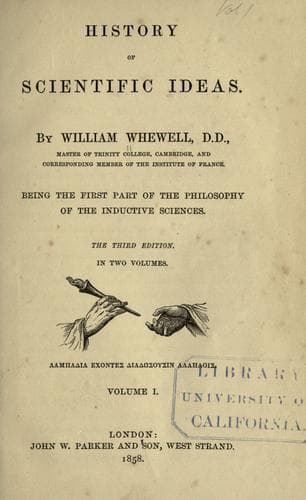
performed in a manner suitable to the time, will have,
something that is new and not unimportant. {7}
Indeed, it appears to be absolutely necessary, in order to
check the prevalence of grave and pernicious errour, that
the doctrines which are taught concerning the foundations of
human knowledge and the powers of the human mind, should be
from time to time revised and corrected or extended.
Erroneous and partial views are promulgated and accepted;
one portion of the truth is insisted upon to the undue
exclusion of another; or principles true in themselves are
exaggerated till they produce on men's minds the effect of
falsehood. When evils of this kind have grown to a serious
height, a _Reform_ is requisite. The faults of the existing
systems must be remedied by correcting what is wrong, and
supplying what is wanting. In such cases, all the merits and
excellencies of the labours of the preceding times do not
supersede the necessity of putting forth new views suited to
the emergency which has arrived. The new form which errour
has assumed makes it proper to endeavour to give a new and
corresponding form to truth. Thus the mere progress of time,
and the natural growth of opinion from one stage to another,
leads to the production of new systems and forms of
philosophy. It will be found, I think, that some of the
doctrines now most widely prevalent respecting the
foundations and nature of truth are of such a kind that a
Reform is needed. The present age seems, by many
indications, to be called upon to seek a sounder Philosophy
of Knowledge than is now current among us. To contribute
towards such a Philosophy is the object of the present work.
The work is, therefore, like all works which take into
account the most recent forms of speculative doctrine,
invested with a certain degree of novelty in its aspect and
import, by the mere time and circumstances of its
appearance.
But, moreover, we can point out a very important peculiarity
by which this work is, in its design, distinguished from
preceding essays on like subjects; and this difference
appears to be of such a kind as may well entitle us to
expect some substantial addition to our knowledge as the
result of our labours. The peculiarity {8} of which I speak
has already been announced;--it is this: that we purpose to
collect our doctrines concerning the nature of knowledge,
and the best mode of acquiring it, from a contemplation of
the Structure and History of those Sciences (the Material
Sciences), which are universally recognized as the clearest
and surest examples of knowledge and of discovery. It is by
surveying and studying the whole mass of such Sciences, and
the various steps of their progress, that we now hope to
approach to the true Philosophy of Science.
Public-domain text, read in full here on John Shaqi.
Reviews
Reviews
No reviews yet
Be the first to share your thoughts on this work.
Join the Discussion
Join the discussion
Sign in to leave a comment or review.
Sign InorCreate an account