I HAVE at various times laid before this Society
dissertations on the metaphysical grounds and elements of
our knowledge, and especially on the foundations of the
science of mechanics. As these speculations have not failed
to excite some attention, both here and elsewhere, I am
tempted to bring forward in the same manner some additional
disquisitions of the same kind. Indeed, the immediate
occasion of the present memoir is of itself an evidence that
such subjects are not supposed to be without their interest
for the general reader; for I am led to the views and
reasonings which I am now about to lay before the Society,
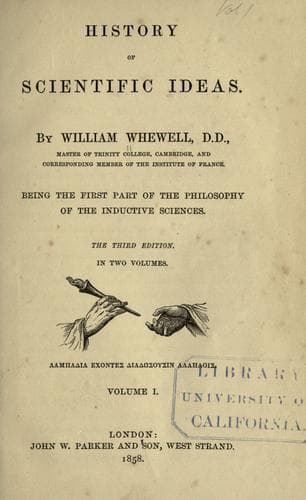
by some remarks in one of our most popular Reviews, (_The
Quarterly Review_, Article on the _History_ and _Philosophy
of the Inductive Sciences_, June 1841). A writer of singular
acuteness and comprehensiveness of view has there made
remarks upon the doctrines which I had delivered in the
_Philosophy of the Inductive Sciences_, which remarks appear
to me in the highest degree instructive and philosophical. I
am not, however, going here to discuss fully the doctrines
contained in this critique. With respect to its general
tendency, I will only observe, that the author does not
accept, in the form in which I had given it, the account of
the origin and ground of necessary and universal truths. I
had stated that our knowledge is derived from Sensations and
Ideas; and that Ideas, which are the conditions of
perception, such as _space_, _time_, _likeness_, _cause_,
make universal and necessary knowledge possible; whereas, if
knowledge were derived from Sensation alone, it could not
have those characters. I have moreover {193} enumerated a
long series of Fundamental Ideas as the bases of a
corresponding series of sciences, of which sciences I have
shown also, by an historical survey, that they claim to
possess universal truths, and have their claims allowed. I
have gone further: for I have stated the Axioms which flow
from these Fundamental Ideas, and which are the logical
grounds of necessity and universality in the truths of each
science, when the science is presented in the form of a
demonstrated system. The Reviewer does not assent to this
doctrine, nor to the argument by which it is supported;
namely, that Experience cannot lead to universal truths,
except by means of a universal Idea supplied by the mind,
and infused into the particular facts which observation
ministers. He considers that the existence of universal
truths in our knowledge may be explained otherwise. He holds
that it is a sufficient account of the matter to say that we
pass from special experience to universal truth in virtue of
'the inductive propensity--the irresistible impulse of the
mind to generalize _ad infinitum_.' I shall not here dwell
upon very strong reasons which may be assigned, as I
conceive, for not accepting this as a full and satisfactory
explanation of the difficulty. Instead of doing so, I shall
Public-domain text, read in full here on John Shaqi.
Reviews
Reviews
No reviews yet
Be the first to share your thoughts on this work.
Elsewhere in the archive
Join the Discussion
Join the discussion
Sign in to leave a comment or review.
Sign InorCreate an account