The _Sciences_ to which the name is most commonly and
unhesitatingly given, are those which are concerned about
the material world; whether they deal with the celestial
bodies, as the sun and stars, or the earth and its products,
or the elements; whether they consider the differences which
prevail among such objects, or their origin, or their mutual
operation. And in all these Sciences it is familiarly
understood and assumed, that their doctrines are obtained by
a common process of collecting general truths from
particular observed facts, which process is termed
_Induction_. It is further assumed that both in these and in
other provinces of knowledge, so long as this process is
duly and legitimately performed, the results will be real
substantial truth. And although this process, with the
conditions under which it is legitimate, and the general
laws of the formation of Sciences, will hereafter be
subjects of discussion in this work, I shall at present so
far adopt the assumption of which I speak, as to give to the
Sciences from which our lessons are to be collected the name
of _Inductive Sciences_. And thus it is that I am led to
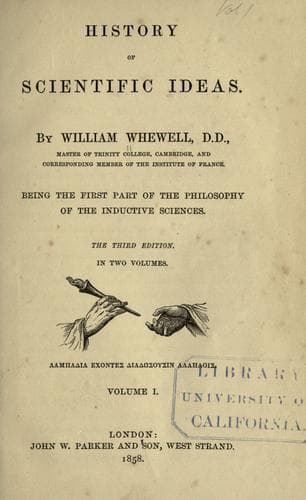
designate my work as THE PHILOSOPHY OF THE INDUCTIVE
SCIENCES.
The views respecting the nature and progress of knowledge,
towards which we shall be directed by such a course of
inquiry as I have pointed out, though derived from those
portions of human knowledge which are more peculiarly and
technically termed _Sciences_, will by no means be confined,
in their bearing, to the domain of such Sciences as deal
with the material world, nor even to the whole range of
Sciences now existing. On the contrary, we shall be led to
believe that the nature of truth is in all subjects the
same, and that its discovery involves, in all cases, the
like {5} conditions. On one subject of human speculation
after another, man's knowledge assumes that exact and
substantial character which leads us to term it _Science_;
and in all these cases, whether inert matter or living
bodies, whether permanent relations or successive
occurrences, be the subject of our attention, we can point
out certain universal characters which belong to truth,
certain general laws which have regulated its progress among
men. And we naturally expect that, even when we extend our
range of speculation wider still, when we contemplate the
world within us as well as the world without us, when we
consider the thoughts and actions of men as well as the
motions and operations of unintelligent bodies, we shall
still find some general analogies which belong to the
essence of truth, and run through the whole intellectual
universe. Hence we have reason to trust that a just
Philosophy of the Sciences may throw light upon the nature
and extent of our knowledge in every department of human
speculation. By considering what is the real import of our
acquisitions, where they are certain and definite, we may
learn something respecting the difference between true
Public-domain text, read in full here on John Shaqi.
Reviews
Reviews
No reviews yet
Be the first to share your thoughts on this work.
Join the Discussion
Join the discussion
Sign in to leave a comment or review.
Sign InorCreate an account