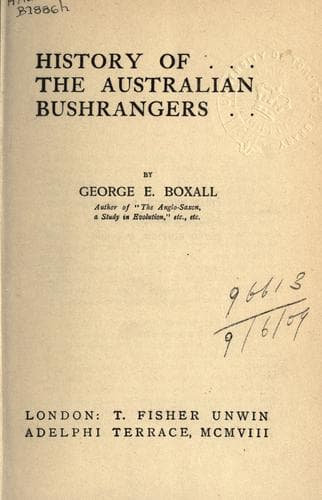
History of the Australian BushrangersBoxall, George
History
History of the Australian Bushrangers
Boxall, George
Bushrangers -- Australia
country district and go to Sydney he might, if he could afford to dress
well, pass as a free man without attracting attention. A blacksmith
named Brady, assigned to Major James Mudie, of Castle Forbes, eluded
the police in this way for nearly two years. He was recognised by a
fellow convict, some time before he was captured, but this man "let
him go for £5." Such cases, however, were exceptions to the general
rule. The majority of runaways went into the bush and not into the
town, and the _Sydney and Hobart Town Gazettes_ in early times contain
numerous proclamations by the various governors calling upon all well
disposed persons to assist the military in capturing runaways. Some
of the issues of these _Gazettes_ contain columns of the names and
descriptions of persons variously styled "absconders," "absentees,"
"bolters," or "bushrangers." In these the term "bushranger" appears
most frequently in New South Wales, while "bolter" was the more popular
in Van Diemen's Land. The first bushrangers, therefore, were men who
"took to the bush" to escape work, and therefore it was quite possible
for a man to be a bushranger without committing any depredations on his
more prosperous fellows.
But laziness was not the sole cause of bushranging in early times.
A more powerful impulse perhaps was discontent, love of change.
"One of the most common indications of the misery of convicts under
existing circumstances is a passionate desire for change of place;
and when serving considerate masters they are sometimes indulged in
this by being transferred (though always as a sort of punishment) to
their disadvantage. In other cases, however, the desire becomes so
strong that they will steal, or commit some equal offence, expressly
to be condemned to a road gang or penal settlement."[6] In fact the
monotony of their lives became insupportable, even in those cases
where they were not cruelly treated. Captain Maconochie cites cases
of men who have so acted within a few months of their being entitled
to a ticket-of-leave, and who have thus forfeited their chances
of freedom in the near future. In some cases this was due to the
"inhuman treatment" of the master. In one case a valuable servant--a
blacksmith--whose time had nearly expired, was goaded into running
away so that he might be condemned to a further term of service before
obtaining his ticket-of-leave, and this was not an isolated case.
Public-domain text, read in full here on John Shaqi.
Reviews
Reviews
No reviews yet
Be the first to share your thoughts on this work.
Join the Discussion
Join the discussion
Sign in to leave a comment or review.
Sign InorCreate an account