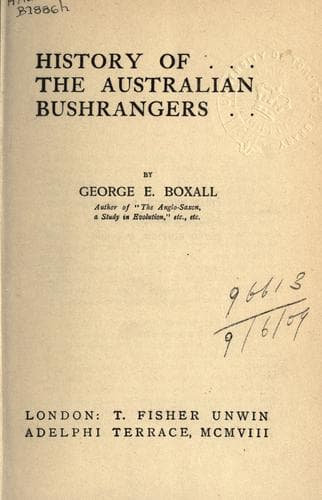
History of the Australian BushrangersBoxall, George
History
History of the Australian Bushrangers
Boxall, George
Bushrangers -- Australia
indulgences to convicts for the capture of any members of a gang which,
under the leadership of a convict named Whitehead, had been committing
depredations on the property of settlers and farmers in the vicinity of
Hobart Town.
Whitehead, therefore, was the first to organise a gang which combined
highway robbery with burglary and petty larceny. Bushrangers were not
at that time specialists. From time to time other proclamations were
issued in which this gang was mentioned, but it was not until May 14th,
1813, that a special proclamation was published, calling upon the
"bolters" to surrender. Those who neglected to obey this order were to
be proclaimed "outlaws" on December 1st.
Very few particulars are published about this gang in the newspapers,
and the proclamations rarely specify the facts in connection with the
robberies committed. The newspapers of the time seldom mention the
names of the bushrangers, and appear to have been quite as averse to
mentioning the Christian names as the modern English papers are those
of professional cricketers. Thus Whitehead is referred to as "the
convict Whitehead," or the "notorious bushranger Whitehead," and so
on. He is debited, however, with one horrible crime. The gang captured
a half-crazy fellow named John Hopkins, and accused him of trying to
betray them. As a punishment for this offence a pair of moccassins,
roughly made of bullock hide, was fitted on to his feet, and in these
were placed a number of the great red ants, commonly known in Australia
as "bull-dog" or "soldier" ants (_myrmecia gulosa_). These ants are
an inch and a quarter long, and of most ferocious appearance. They are
the dread of the colonists. They sting quite as severely as a bee or a
hornet. But a bee stings only once, while a soldier ant will continue
to sting until removed. It is always ready to fight, and never lets go
when it has taken hold; hence its popular names. The horrible barbarity
of such a punishment can be best appreciated, perhaps, by those who
have inadvertently stood on a "soldier's" bed or nest. The victim is
said to have died in agony.
Public-domain text, read in full here on John Shaqi.
Reviews
Reviews
No reviews yet
Be the first to share your thoughts on this work.
Join the Discussion
Join the discussion
Sign in to leave a comment or review.
Sign InorCreate an account