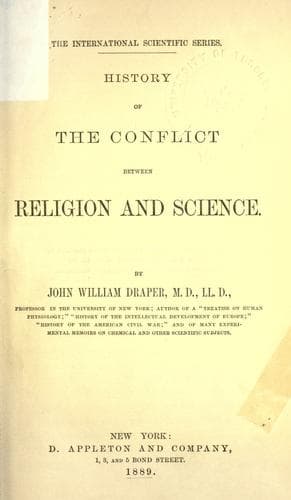
History of the Conflict Between Religion and ScienceDraper, John William
Religion
History of the Conflict Between Religion and Science
Draper, John William
Religion and science -- History
The individual, or passive, or subjective intellect, is an emanation
from the universal, and constitutes what is termed the soul of man. In
one sense it is perishable and ends with the body, but in a higher
sense it endures; for, after death, it returns to or is absorbed in the
universal soul, and thus of all human souls there remains at last
but one--the aggregate of them all, life is not the property of the
individual, it belongs to Nature. The end of, man is to enter into union
more and more complete with the active intellect--reason. In that the
happiness of the soul consists. Our destiny is quietude. It was the
opinion of Averroes that the transition from the individual to the
universal is instantaneous at death, but the Buddhists maintain that
human personality continues in a declining manner for a certain term
before nonentity, or Nirwana, is attained.
Philosophy has never proposed but two hypotheses to explain the system
of the world: first, a personal God existing apart, and a human soul
called into existence or created, and thenceforth immortal; second, an
impersonal intelligence, or indeterminate God, and a soul emerging from
and returning to him. As to the origin of beings, there are two opposite
opinions: first, that they are created from nothing; second, that they
come by development from pre-existing forms. The theory of creation
belongs to the first of the above hypotheses, that of evolution to the
last.
Philosophy among the Arabs thus took the same direction that it had
taken in China, in India, and indeed throughout the East. Its whole
spirit depended on the admission of the indestructibility of matter and
force. It saw an analogy between the gathering of the material of which
the body of man consists from the vast store of matter in Nature, and
its final restoration to that store, and the emanation of the spirit
of man from the universal Intellect, the Divinity, and its final
reabsorption.
Having thus indicated in sufficient detail the philosophical
characteristics of the doctrine of emanation and absorption, I have in
the next place to relate its history. It was introduced into Europe by
the Spanish Arabs. Spain was the focal point from which, issuing forth,
it affected the ranks of intelligence and fashion all over Europe, and
in Spain it had a melancholy end.
Public-domain text, read in full here on John Shaqi.
Reviews
Reviews
No reviews yet
Be the first to share your thoughts on this work.
Elsewhere in the archive
Join the Discussion
Join the discussion
Sign in to leave a comment or review.
Sign InorCreate an account