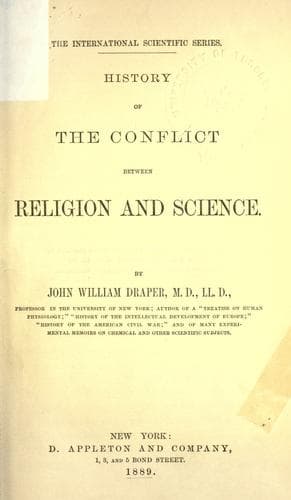
History of the Conflict Between Religion and ScienceDraper, John William
Religion
History of the Conflict Between Religion and Science
Draper, John William
Religion and science -- History
The Spanish khalifs had surrounded themselves with all the luxuries
of Oriental life. They had magnificent palaces, enchanting gardens,
seraglios filled with beautiful women. Europe at the present day does
not offer more taste, more refinement, more elegance, than might have
been seen, at the epoch of which we are speaking, in the capitals of the
Spanish Arabs. Their streets were lighted and solidly paved. The houses
were frescoed and carpeted; they were warmed in winter by furnaces, and
cooled in summer with perfumed air brought by underground pipes from
flower-beds. They had baths, and libraries, and dining-halls, fountains
of quicksilver and water. City and country were full of conviviality,
and of dancing to the lute and mandolin. Instead of the drunken and
gluttonous wassail orgies of their Northern neighbors, the feasts of the
Saracens were marked by sobriety. Wine was prohibited. The enchanting
moonlight evenings of Andalusia were spent by the Moors in sequestered,
fairy-like gardens or in orange-groves, listening to the romances of
the story-teller, or engaged in philosophical discourse; consoling
themselves for the disappointments of this life by such reflections
as that, if virtue were rewarded in this world, we should be without
expectations in the life to come; and reconciling themselves to their
daily toil by the expectation that rest will be found after death--a
rest never to be succeeded by labor.
In the tenth century the Khalif Hakein II. had made beautiful Andalusia
the paradise of the world. Christians, Mussulmen, Jews, mixed together
without restraint. There, among many celebrated names that have
descended to our times, was Gerbert, destined subsequently to
become pope. There, too, was Peter the Venerable, and many Christian
ecclesiastics. Peter says that he found learned men even from Britain
pursuing astronomy. All learned men, no matter from what country they
came, or what their religious views, were welcomed. The khalif had in
his palace a manufactory of books, and copyists, binders, illuminators.
He kept book-buyers in all the great cities of Asia and Africa. His
library contained four hundred thousand volumes, superbly bound and
illuminated.
Throughout the Mohammedan dominions in Asia, in Africa, and in Spain,
the lower order of Mussulmen entertained a fanatical hatred against
learning. Among the more devout--those who claimed to be orthodox--there
were painful doubts as to the salvation of the great Khalif
Al-Mamun--the wicked khalif, as they called him--for he had not only
disturbed the people by introducing the writings of Aristotle and other
Greek heathens, but had even struck at the existence of heaven and
hell by saying that the earth is a globe, and pretending that he could
measure its size. These persons, from their numbers, constituted a
political power.
Public-domain text, read in full here on John Shaqi.
Reviews
Reviews
No reviews yet
Be the first to share your thoughts on this work.
Elsewhere in the archive
Join the Discussion
Join the discussion
Sign in to leave a comment or review.
Sign InorCreate an account