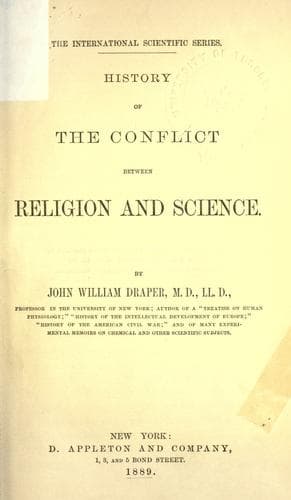
History of the Conflict Between Religion and ScienceDraper, John William
Religion
History of the Conflict Between Religion and Science
Draper, John William
Religion and science -- History
Thomas belonged, was
sharpened by the fact that their rivals, the Franciscans, inclined to
Averroistic views; and Dante, who leaned to the Dominicans, denounced
Averroes as the author of a most dangerous system. The theological odium
of all three dominant religions was put upon him; he was pointed out
as the originator of the atrocious maxim that "all religions are false,
although all are probably useful." An attempt was made at the Council
of Vienne to have his writings absolutely suppressed, and to forbid all
Christians reading them. The Dominicans, armed with the weapons of
the Inquisition, terrified Christian Europe with their unrelenting
persecutions. They imputed all the infidelity of the times to the
Arabian philosopher. But he was not without support. In Paris and in the
cities of Northern Italy the Franciscans sustained his views, and all
Christendom was agitated with these disputes.
Under the inspiration of the Dominicans, Averroes became to the Italian
painters the emblem of unbelief. Many of the Italian towns had pictures
or frescoes of the Day of Judgment and of Hell. In these Averroes not
unfrequently appears. Thus, in one at Pisa, he figures with Arius,
Mohammed, and Antichrist. In another he is represented as overthrown by
St. Thomas. He had become an essential element in the triumphs of the
great Dominican doctor. He continued thus to be familiar to the Italian
painters until the sixteenth century. His doctrines were maintained in
the University of Padua until the seventeenth.
Such is, in brief, the history of Averroism as it invaded Europe from
Spain. Under the auspices of Frederick II., it, in a less imposing
manner, issued from Sicily. That sovereign bad adopted it fully. In his
"Sicilian Questions" he had demanded light on the eternity of the world,
and on the nature of the soul, and supposed he had found it in the
replies of Ibn Sabin, an upholder of these doctrines. But in his
conflict with the papacy be was overthrown, and with him these heresies
were destroyed.
In Upper Italy, Averroism long maintained its ground. It was so
fashionable in high Venetian society that every gentleman felt
constrained to profess it. At length the Church took decisive action
against it. The Lateran Council, A.D. 1512, condemned the abettors of
these detestable doctrines to be held as heretics and infidels. As
we have seen, the late Vatican Council has anathematized them.
Notwithstanding that stigma, it is to be borne in mind that these
opinions are held to be true by a majority of the human race.
CHAPTER VI.
CONFLICT RESPECTING THE NATURE OF THE WORLD.
Scriptural view of the world: the earth a flat surface;
location of heaven and hell.
Public-domain text, read in full here on John Shaqi.
Reviews
Reviews
No reviews yet
Be the first to share your thoughts on this work.
Elsewhere in the archive
Join the Discussion
Join the discussion
Sign in to leave a comment or review.
Sign InorCreate an account