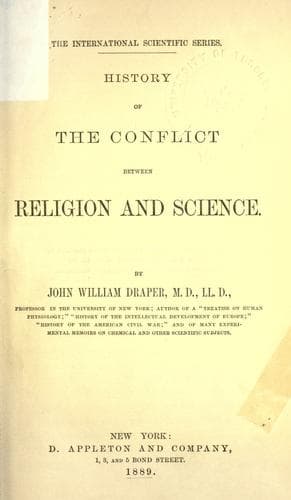
History of the Conflict Between Religion and ScienceDraper, John William
Religion
History of the Conflict Between Religion and Science
Draper, John William
Religion and science -- History
Scientific view: the earth a globe; its size determined; its
position in and relations to the solar system.--The three
great voyages.--Columbus, De Gama, Magellan.--
Circumnavigation of the earth.--Determination of its
curvature by the measurement of a degree and by the
pendulum.
The discoveries of Copernicus.--Invention of the telescope.--
Galileo brought before the Inquisition.--His punishment.--
Victory over the Church.
Attempts to ascertain the dimensions of the solar system.--
Determination of the sun's parallax by the transits of
Venus.--Insignificance, of the earth and man.
Ideas respecting the dimensions of the universe.--Parallax
of the stars.--The plurality of worlds asserted by Bruno.--
He is seized and murdered by the Inquisition.
I HAVE now to present the discussions that arose respecting the third
great philosophical problem--the nature of the world.
An uncritical observation of the aspect of Nature persuades us that the
earth is an extended level surface which sustains the dome of the sky,
a firmament dividing the waters above from the waters beneath; that the
heavenly bodies--the sun, the moon, the stars--pursue their way,
moving from east to west, their insignificant size and motion round the
motionless earth proclaiming their inferiority. Of the various organic
forms surrounding man none rival him in dignity, and hence he seems
justified in concluding that every thing has been created for his
use--the sun for the purpose of giving him light by day, the moon and
stars by night.
Comparative theology shows us that this is the conception of Nature
universally adopted in the early phase of intellectual life. It is the
belief of all nations in all parts of the world in the beginning of
their civilization: geocentric, for it makes the earth the centre of the
universe; anthropocentric, for it makes man the central object of the
earth. And not only is this the conclusion spontaneously come to from
inconsiderate glimpses of the world, it is also the philosophical basis
of various religious revelations, vouchsafed to man from time to time.
These revelations, moreover, declare to him that above the crystalline
dome of the sky is a region of eternal light and happiness--heaven--the
abode of God and the angelic hosts, perhaps also his own abode after
death; and beneath the earth a region of eternal darkness and misery,
the habitation of those that are evil. In the visible world is thus seen
a picture of the invisible.
On the basis of this view of the structure of the world great religious
systems have been founded, and hence powerful material interests have
been engaged in its support. These have resisted, sometimes by resorting
to bloodshed, attempts that have been made to correct its incontestable
errors--a resistance grounded on the suspicion that the localization of
heaven and hell and the supreme value of man in the universe might be
affected.
Public-domain text, read in full here on John Shaqi.
Reviews
Reviews
No reviews yet
Be the first to share your thoughts on this work.
Elsewhere in the archive
Join the Discussion
Join the discussion
Sign in to leave a comment or review.
Sign InorCreate an account