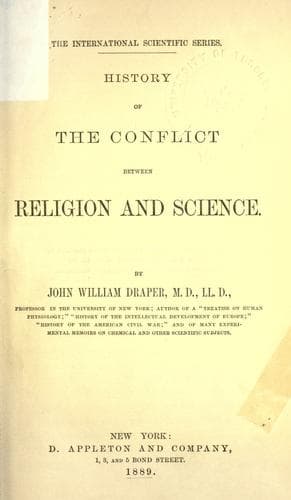
History of the Conflict Between Religion and ScienceDraper, John William
Religion
History of the Conflict Between Religion and Science
Draper, John William
Religion and science -- History
That such attempts would be made was inevitable. As soon as men began
to reason on the subject at all, they could not fail to discredit the
assertion that the earth is an indefinite plane. No one can doubt that
the sun we see to-day is the self-same sun that we saw yesterday. His
reappearance each morning irresistibly suggests that he has passed on
the underside of the earth. But this is incompatible with the reign of
night in those regions. It presents more or less distinctly the idea of
the globular form of the earth.
The earth cannot extend indefinitely downward; for the sun cannot go
through it, nor through any crevice or passage in it, Since he rises and
sets in different positions at different seasons of the year. The stars
also move under it in countless courses. There must, therefore, be a
clear way beneath.
To reconcile revelation with these innovating facts, schemes, such
as that of Cosmas Indicopleustes in his Christian Topography, were
doubtless often adopted. To this in particular we have had occasion on a
former page to refer. It asserted that in the northern parts of the flat
earth there is an immense mountain, behind which the sun passes, and
thus produces night.
At a very remote historical period the mechanism of eclipses had been
discovered. Those of the moon demonstrated that the shadow of the earth
is always circular. The form of the earth must therefore be globular.
A body which in all positions casts a circular shadow must itself be
spherical. Other considerations, with which every one is now familiar,
could not fail to establish that such is her figure.
But the determination of the shape of the earth by no means deposed
her from her position of superiority. Apparently vastly larger than all
other things, it was fitting that she should be considered not merely as
the centre of the world, but, in truth, as--the world. All other objects
in their aggregate seemed utterly unimportant in comparison with her.
Public-domain text, read in full here on John Shaqi.
Reviews
Reviews
No reviews yet
Be the first to share your thoughts on this work.
Elsewhere in the archive
Join the Discussion
Join the discussion
Sign in to leave a comment or review.
Sign InorCreate an account