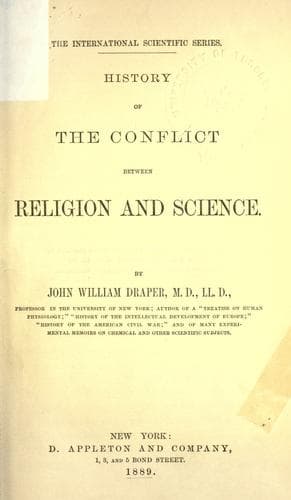
History of the Conflict Between Religion and ScienceDraper, John William
Religion
History of the Conflict Between Religion and Science
Draper, John William
Religion and science -- History
Copernicus, a Prussian, about the year 1507, had completed a book "On
the Revolutions of the Heavenly Bodies." He had journeyed to Italy
in his youth, had devoted his attention to astronomy, and had taught
mathematics at Rome. From a profound study of the Ptolemaic and
Pythagorean systems, he had come to a conclusion in favor of the latter,
the object of his book being to sustain it. Aware that his doctrines
were totally opposed to revealed truth, and foreseeing that they would
bring upon him the punishments of the Church, he expressed himself in
a cautious and apologetic manner, saying that he had only taken the
liberty of trying whether, on the supposition of the earth's motion, it
was possible to find better explanations than the ancient ones of the
revolutions of the celestial orbs; that in doing this he had only
taken the privilege that had been allowed to others, of feigning what
hypothesis they chose. The preface was addressed to Pope Paul III.
Full of misgivings as to what might be the result, he refrained from
publishing his book for thirty-six years, thinking that "perhaps it
might be better to follow the examples of the Pythagoreans and others,
who delivered their doctrine only by tradition and to friends." At the
entreaty of Cardinal Schomberg he at length published it in 1543. A copy
of it was brought to him on his death-bed. Its fate was such as he had
anticipated. The Inquisition condemned it as heretical. In their decree,
prohibiting it, the Congregation of the Index denounced his system
as "that false Pythagorean doctrine utterly contrary to the Holy
Scriptures."
Astronomers justly affirm that the book of Copernicus, "De
Revolutionibus," changed the face of their science. It incontestably
established the heliocentric theory. It showed that the distance of the
fixed stars is infinitely great, and that the earth is a mere point in
the heavens. Anticipating Newton, Copernicus imputed gravity to the sun,
the moon, and heavenly bodies, but he was led astray by assuming that
the celestial motions must be circular. Observations on the orbit of
Mars, and his different diameters at different times, had led Copernicus
to his theory.
In thus denouncing the Copernican system as being in contradiction to
revelation, the ecclesiastical authorities were doubtless deeply moved
by inferential considerations. To dethrone the earth from her central
dominating position, to give her many equals and not a few superiors,
seemed to diminish her claims upon the Divine regard. If each of the
countless myriads of stars was a sun, surrounded by revolving globes,
peopled with responsible beings like ourselves, if we had fallen so
easily and had been redeemed at so stupendous a price as the death of
the Son of God, how was it with them? Of them were there none who had
fallen or might fall like us? Where, then, for them could a Savior be
found?
Public-domain text, read in full here on John Shaqi.
Reviews
Reviews
No reviews yet
Be the first to share your thoughts on this work.
Elsewhere in the archive
Join the Discussion
Join the discussion
Sign in to leave a comment or review.
Sign InorCreate an account