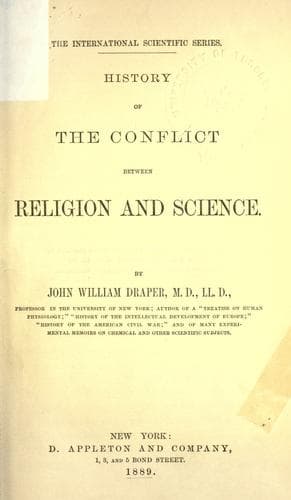
History of the Conflict Between Religion and ScienceDraper, John William
Religion
History of the Conflict Between Religion and Science
Draper, John William
Religion and science -- History
During the year 1608 one Lippershey, a Hollander, discovered that, by
looking through two glass lenses, combined in a certain manner together,
distant objects were magnified and rendered very plain. He had invented
the telescope. In the following year Galileo, a Florentine, greatly
distinguished by his mathematical and scientific writings, hearing
of the circumstance, but without knowing the particulars of the
construction, invented a form of the instrument for himself. Improving
it gradually, he succeeded in making one that could magnify thirty
times. Examining the moon, he found that she had valleys like those of
the earth, and mountains casting shadows. It had been said in the old
times that in the Pleiades there were formerly seven stars, but a legend
related that one of them had mysteriously disappeared. On turning his
telescope toward them, Galileo found that he could easily count not
fewer than forty. In whatever direction he looked, he discovered stars
that were totally invisible to the naked eye.
On the night of January 7, 1610, he perceived three small stars in
a straight line, adjacent to the planet Jupiter, and, a few evenings
later, a fourth. He found that these were revolving in orbits round the
body of the planet, and, with transport, recognized that they presented
a miniature representation of the Copernican system.
The announcement of these wonders at once attracted universal attention.
The spiritual authorities were not slow to detect their tendency, as
endangering the doctrine that the universe was made for man. In the
creation of myriads of stars, hitherto invisible, there must surely have
been some other motive than that of illuminating the nights for him.
It had been objected to the Copernican theory that, if the planets
Mercury and Venus move round the sun in orbits interior to that of the
earth, they ought to show phases like those of the moon; and that in
the case of Venus, which is so brilliant and conspicuous, these phases
should be very obvious. Copernicus himself had admitted the force of
the objection, and had vainly tried to find an explanation. Galileo, on
turning his telescope to the planet, discovered that the expected phases
actually exist; now she was a crescent, then half-moon, then gibbous,
then full. Previously to Copernicus, it was supposed that the planets
shine by their own light, but the phases of Venus and Mars proved that
their light is reflected. The Aristotelian notion, that celestial differ
from terrestrial bodies in being incorruptible, received a rude shock
from the discoveries of Galileo, that there are mountains and valleys in
the moon like those of the earth, that the sun is not perfect, but has
spots on his face, and that he turns on his axis instead of being in a
state of majestic rest. The apparition of new stars had already thrown
serious doubts on this theory of incorruptibility.
Public-domain text, read in full here on John Shaqi.
Reviews
Reviews
No reviews yet
Be the first to share your thoughts on this work.
Elsewhere in the archive
Join the Discussion
Join the discussion
Sign in to leave a comment or review.
Sign InorCreate an account