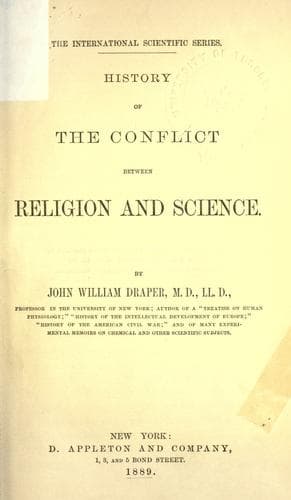
History of the Conflict Between Religion and ScienceDraper, John William
Religion
History of the Conflict Between Religion and Science
Draper, John William
Religion and science -- History
But, on the discussion of the observations made at the different
stations, it was found that there was not the accordance that could have
been desired--the result varying from eighty-eight to one hundred and
nine million. The celebrated mathematician, Encke, therefore reviewed
them in 1822-'24, and came to the conclusion that the sun's horizontal
parallax, that is, the angle under which the semi-diameter of the earth
is seen from the sun, is 8 576/1000 seconds; this gave as the distance
95,274,000 miles. Subsequently the observations were reconsidered
by Hansen, who gave as their result 91,659,000 miles. Still later,
Leverrier made it 91,759,000. Airy and Stone, by another method, made
it 91,400,000; Stone alone, by a revision of the old observations,
91,730,000; and finally, Foucault and Fizeau, from physical experiments,
determining the velocity of light, and therefore in their nature
altogether differing from transit observations, 91,400,000. Until the
results of the transit of next year (1874) are ascertained, it must
therefore be admitted that the distance of the earth from the sun is
somewhat less than ninety-two million miles.
This distance once determined, the dimensions of the solar system may
be ascertained with ease and precision. It is enough to mention that
the distance of Neptune from the sun, the most remote of the planets at
present known, is about thirty times that of the earth.
By the aid of these numbers we may begin to gain a just appreciation of
the doctrine of the human destiny of the universe--the doctrine that all
things were made for man. Seen from the sun, the earth dwindles away to
a mere speck, a mere dust-mote glistening in his beams. If the reader
wishes a more precise valuation, let him hold a page of this book a
couple of feet from his eye; then let him consider one of its dots or
full stops; that dot is several hundred times larger in surface than is
the earth as seen from the sun!
Of what consequence, then, can such an almost imperceptible particle be?
One might think that it could be removed or even annihilated, and yet
never be missed. Of what consequence is one of those human monads, of
whom more than a thousand millions swarm on the surface of this all
but invisible speck, and of a million of whom scarcely one will leave
a trace that he has ever existed? Of what consequence is man, his
pleasures or his pains?
Public-domain text, read in full here on John Shaqi.
Reviews
Reviews
No reviews yet
Be the first to share your thoughts on this work.
Elsewhere in the archive
Join the Discussion
Join the discussion
Sign in to leave a comment or review.
Sign InorCreate an account