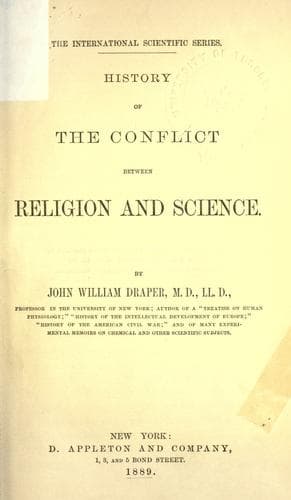
History of the Conflict Between Religion and ScienceDraper, John William
Religion
History of the Conflict Between Religion and Science
Draper, John William
Religion and science -- History
The triumphant establishment of the Copernican doctrine dates from the
invention of the telescope. Soon there was not to be found in all Europe
an astronomer who had not accepted the heliocentric theory with its
essential postulate, the double motion of the earth--movement of
rotation on her axis, and a movement of revolution round the sun.
If additional proof of the latter were needed, it was furnished by
Bradley's great discovery of the aberration of the fixed stars, an
aberration depending partly on the progressive motion of light, and
partly on the revolution of the earth. Bradley's discovery ranked
in importance with that of the precession of the equinoxes. Roemer's
discovery of the progressive motion of light, though denounced by
Fontenelle as a seductive error, and not admitted by Cassini, at length
forced its way to universal acceptance.
Next it was necessary to obtain correct ideas of the dimensions of the
solar system, or, putting the problem under a more limited form, to
determine the distance of the earth from the sun.
In the time of Copernicus it was supposed that the sun's distance could
not exceed five million miles, and indeed there were many who thought
that estimate very extravagant. From a review of the observations of
Tycho Brahe, Kepler, however, concluded that the error was actually in
the opposite direction, and that the estimate must be raised to at
least thirteen million. In 1670 Cassini showed that these numbers were
altogether inconsistent with the facts, and gave as his conclusion
eighty-five million.
The transit of Venus over the face of the sun, June 3, 1769, had been
foreseen, and its great value in the solution of this fundamental
problem in astronomy appreciated. With commendable alacrity various
governments contributed their assistance in making observations, so that
in Europe there were fifty stations, in Asia six, in America seventeen.
It was for this purpose that the English Government dispatched Captain
Cook on his celebrated first voyage. He went to Otaheite. His voyage
was crowned with success. The sun rose without a cloud, and the sky
continued equally clear throughout the day. The transit at Cook's
station lasted from about half-past nine in the morning until about
half-past three in the afternoon, and all the observations were made in
a satisfactory manner.
Public-domain text, read in full here on John Shaqi.
Reviews
Reviews
No reviews yet
Be the first to share your thoughts on this work.
Elsewhere in the archive
Join the Discussion
Join the discussion
Sign in to leave a comment or review.
Sign InorCreate an account