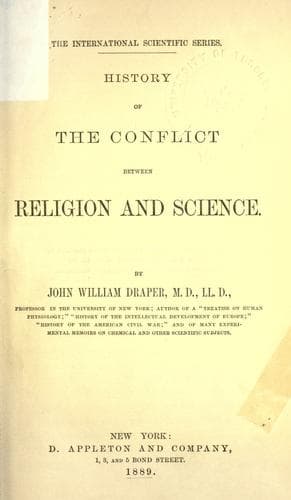
History of the Conflict Between Religion and ScienceDraper, John William
Religion
History of the Conflict Between Religion and Science
Draper, John William
Religion and science -- History
The stars, then, differ not merely in visible magnitude, but also in
actual size. As the spectroscope shows, they differ greatly in chemical
and physical constitution. That instrument is also revealing to us the
duration of the life of a star, through changes in the refrangibility of
the emitted light. Though, as we have seen, the nearest to us is at
an enormous and all but immeasurable distance, this is but the first
step--there are others the rays of which have taken thousands, perhaps
millions, of years to reach us! The limits of our own system are far
beyond the range of our greatest telescopes; what, then, shall we say of
other systems beyond? Worlds are scattered like dust in the abysses in
space.
Have these gigantic bodies--myriads of which are placed at so vast a
distance that our unassisted eyes cannot perceive them--have these no
other purpose than that assigned by theologians, to give light to us?
Does not their enormous size demonstrate that, as they are centres of
force, so they must be centres of motion--suns for other systems of
worlds?
While yet these facts were very imperfectly known--indeed, were rather
speculations than facts--Giordano Bruno, an Italian, born seven years
after the death of Copernicus, published a work on the "Infinity of
the Universe and of Worlds;" he was also the author of "Evening
Conversations on Ash-Wednesday," an apology for the Copernican system,
and of "The One Sole Cause of Things." To these may be added an allegory
published in 1584, "The Expulsion of the Triumphant Beast." He had also
collected, for the use of future astronomers, all the observations he
could find respecting the new star that suddenly appeared in Cassiopeia,
A.D. 1572, and increased in brilliancy, until it surpassed all the other
stars. It could be plainly seen in the daytime. On a sudden, November
11th, it was as bright as Venus at her brightest. In the following March
it was of the first magnitude. It exhibited various hues of color in a
few months, and disappeared in March, 1574.
The star that suddenly appeared in Serpentarius, in Kepler's time
(1604), was at first brighter than Venus. It lasted more than a year,
and, passing through various tints of purple, yellow, red, became
extinguished.
Originally, Bruno was intended for the Church. He had become a
Dominican, but was led into doubt by his meditations on the subjects of
transubstantiation and the immaculate conception. Not caring to
conceal his opinions, he soon fell under the censure of the spiritual
authorities, and found it necessary to seek refuge successively in
Switzerland, France, England, Germany. The cold-scented sleuth-hounds of
the Inquisition followed his track remorselessly, and eventually hunted
him back to Italy. He was arrested in Venice, and confined in the Piombi
for six years, without books, or paper, or friends.
Public-domain text, read in full here on John Shaqi.
Reviews
Reviews
No reviews yet
Be the first to share your thoughts on this work.
Elsewhere in the archive
Join the Discussion
Join the discussion
Sign in to leave a comment or review.
Sign InorCreate an account