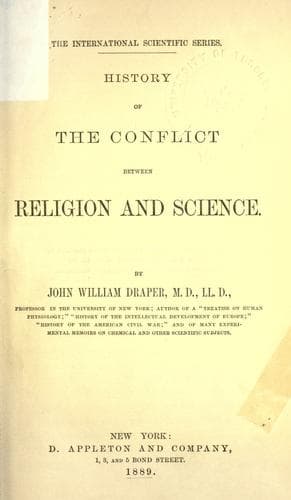
History of the Conflict Between Religion and ScienceDraper, John William
Religion
History of the Conflict Between Religion and Science
Draper, John William
Religion and science -- History
In England he had given lectures on the plurality of worlds, and in that
country had written, in Italian, his most important works. It added
not a little to the exasperation against him, that he was perpetually
declaiming against the insincerity; the impostures, of his
persecutors--that wherever he went he found skepticism varnished over
and concealed by hypocrisy; and that it was not against the belief of
men, but against their pretended belief, that he was fighting; that he
was struggling with an orthodoxy that had neither morality nor faith.
In his "Evening Conversations" he had insisted that the Scriptures were
never intended to teach science, but morals only; and that they cannot
be received as of any authority on astronomical and physical subjects.
Especially must we reject the view they reveal to us of the constitution
of the world, that the earth is a flat surface, supported on pillars;
that the sky is a firmament--the floor of heaven. On the contrary, we
must believe that the universe is infinite, and that it is filled with
self-luminous and opaque worlds, many of them inhabited; that there
is nothing above and around us but space and stars. His meditations
on these subjects had brought him to the conclusion that the views of
Averroes are not far from the truth--that there is an Intellect which
animates the universe, and of this Intellect the visible world is only
an emanation or manifestation, originated and sustained by force derived
from it, and, were that force withdrawn, all things would disappear.
This ever-present, all-pervading Intellect is God, who lives in all
things, even such as seem not to live; that every thing is ready to
become organized, to burst into life. God is, therefore, "the One Sole
Cause of Things," "the All in All."
Bruno may hence be considered among philosophical writers as
intermediate between Averroes and Spinoza. The latter held that God and
the Universe are the same, that all events happen by an immutable law
of Nature, by an unconquerable necessity; that God is the Universe,
producing a series of necessary movements or acts, in consequence of
intrinsic, unchangeable, and irresistible energy.
Public-domain text, read in full here on John Shaqi.
Reviews
Reviews
No reviews yet
Be the first to share your thoughts on this work.
Elsewhere in the archive
Join the Discussion
Join the discussion
Sign in to leave a comment or review.
Sign InorCreate an account