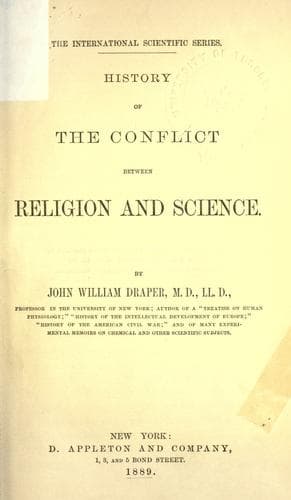
History of the Conflict Between Religion and ScienceDraper, John William
Religion
History of the Conflict Between Religion and Science
Draper, John William
Religion and science -- History
On the demand of the spiritual authorities, Bruno was removed from
Venice to Rome, and confined in the prison of the Inquisition, accused
not only of being a heretic, but also a heresiarch, who had written
things unseemly concerning religion; the special charge against him
being that he had taught the plurality of worlds, a doctrine repugnant
to the whole tenor of Scripture and inimical to revealed religion,
especially as regards the plan of salvation. After an imprisonment of
two years he was brought before his judges, declared guilty of the
acts alleged, excommunicated, and, on his nobly refusing to recant, was
delivered over to the secular authorities to be punished "as mercifully
as possible, and without the shedding of his blood," the horrible
formula for burning a prisoner at the stake. Knowing well that though
his tormentors might destroy his body, his thoughts would still live
among men, he said to his judges, "Perhaps it is with greater fear
that you pass the sentence upon me than I receive it." The sentence was
carried into effect, and he was burnt at Rome, February 16th, A.D. 1600.
No one can recall without sentiments of pity the sufferings of those
countless martyrs, who first by one party, and then by another, have
been brought for their religious opinions to the stake. But each of
these had in his supreme moment a powerful and unfailing support. The
passage from this life to the next, though through a hard trial, was the
passage from a transient trouble to eternal happiness, an escape from
the cruelty of earth to the charity of heaven. On his way through the
dark valley the martyr believed that there was an invisible hand that
would lead him, a friend that would guide him all the more gently and
firmly because of the terrors of the flames. For Bruno there was no
such support. The philosophical opinions, for the sake of which he
surrendered his life, could give him no consolation. He must fight the
last fight alone. Is there not something very grand in the attitude of
this solitary man, something which human nature cannot help admiring, as
he stands in the gloomy hall before his inexorable judges? No accuser,
no witness, no advocate is present, but the familiars of the Holy
Office, clad in black, are stealthily moving about. The tormentors and
the rack are in the vaults below. He is simply told that he has brought
upon himself strong suspicions of heresy, since he has said that there
are other worlds than ours. He is asked if he will recant and abjure
his error. He cannot and will not deny what he knows to be true, and
perhaps--for he had often done so before--he tells his judges that they,
too, in their hearts are of the same belief. What a contrast between
this scene of manly honor, of unshaken firmness, of inflexible adherence
to the truth, and that other scene which took place more than fifteen
centuries previously by the fireside in the hall of Caiaphas the
Public-domain text, read in full here on John Shaqi.
Reviews
Reviews
No reviews yet
Be the first to share your thoughts on this work.
Elsewhere in the archive
Join the Discussion
Join the discussion
Sign in to leave a comment or review.
Sign InorCreate an account