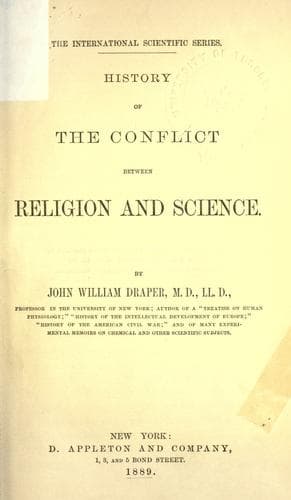
History of the Conflict Between Religion and ScienceDraper, John William
Religion
History of the Conflict Between Religion and Science
Draper, John William
Religion and science -- History
The Greek Fathers computed that, at the time of the dispersion,
seventy-two nations were formed, and in this conclusion St. Augustine
coincides. But difficulties seem to have been recognized in these
computations; thus the learned Dr. Shuckford, who has treated very
elaborately on all the foregoing points in his excellent work "On the
Sacred and Profane History of the World connected," demonstrates that
there could not have been more than twenty-one or twenty-two men, women,
and children, in each of those kingdoms.
A very vital point in this system of chronological computation, based
upon the ages of the patriarchs, was the great length of life to which
those worthies attained. It was generally supposed that before the Flood
"there was a perpetual equinox," and no vicissitudes in Nature. After
that event the standard of life diminished one-half, and in the time of
the Psalmist it had sunk to seventy years, at which it still remains.
Austerities of climate were affirmed to have arisen through the shifting
of the earth's axis at the Flood, and to this ill effect were added the
noxious influences of that universal catastrophe, which, "converting the
surface of the earth into a vast swamp, gave rise to fermentations of
the blood and a weakening of the fibres."
With a view of avoiding difficulties arising from the extraordinary
length of the patriarchal lives, certain divines suggested that the
years spoken of by the sacred penman were not ordinary but lunar years.
This, though it might bring the age of those venerable men within
the recent term of life, introduced, however, another insuperable
difficulty, since it made them have children when only five or six years
old.
Sacred science, as interpreted by the Fathers of the Church,
demonstrated these facts: 1. That the date of Creation was comparatively
recent, not more than four or five thousand years before Christ; 2. That
the act of Creation occupied the space of six ordinary days; 3. That
the Deluge was universal, and that the animals which survived it were
preserved in an ark; 4. That Adam was created perfect in morality and
intelligence, that he fell, and that his descendants have shared in his
sin and his fall.
Of these points and others that might be mentioned there were two on
which ecclesiastical authority felt that it must insist. These were:
1. The recent date of Creation; for, the remoter that event, the more
urgent the necessity of vindicating the justice of God, who apparently
had left the majority of our race to its fate, and had reserved
salvation for the few who were living in the closing ages of the
world; 2. The perfect condition of Adam at his creation, since this was
necessary to the theory of the fall, and the plan of salvation.
Public-domain text, read in full here on John Shaqi.
Reviews
Reviews
No reviews yet
Be the first to share your thoughts on this work.
Elsewhere in the archive
Join the Discussion
Join the discussion
Sign in to leave a comment or review.
Sign InorCreate an account