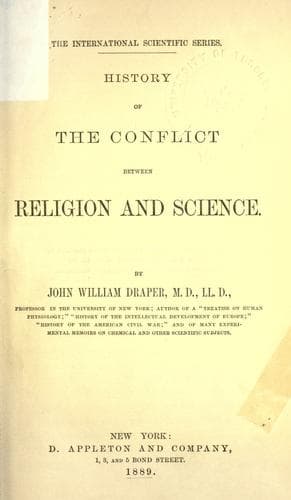
History of the Conflict Between Religion and ScienceDraper, John William
Religion
History of the Conflict Between Religion and Science
Draper, John William
Religion and science -- History
Theological authorities were therefore constrained to look with disfavor
on any attempt to carry back the origin of the earth, to an epoch
indefinitely remote, and on the Mohammedan theory of the evolution
of man from lower forms, or his gradual development to his present
condition in the long lapse of time.
From the puerilities, absurdities, and contradictions of the foregoing
statement, we may gather how very unsatisfactory this so-called sacred
science was. And perhaps we may be brought to the conclusion to
which Dr. Shuckford, above quoted, was constrained to come, after his
wearisome and unavailing attempt to coordinate its various parts: "As to
the Fathers of the first ages of the Church, they were good men, but not
men of universal learning."
Sacred cosmogony regards the formation and modeling of the earth as the
direct act of God; it rejects the intervention of secondary causes in
those events.
Scientific cosmogony dates from the telescopic discovery made by
Cassini--an Italian astronomer, under whose care Louis XIV. placed the
Observatory of Paris--that the planet Jupiter is not a sphere, but
an oblate spheroid, flattened at the poles. Mechanical philosophy
demonstrated that such a figure is the necessary result of the rotation
of a yielding mass, and that the more rapid the rotation the greater the
flattening, or, what comes to the same thing, the greater the equatorial
bulging must be.
From considerations--purely of a mechanical kind--Newton had foreseen
that such likewise, though to a less striking extent, must be the figure
of the earth. To the protuberant mass is due the precession of the
equinoxes, which requires twenty-five thousand eight hundred and
sixty-eight years for its completion, and also the nutation of the
earth's axis, discovered by Bradley. We have already had occasion to
remark that the earth's equatorial diameter exceeds the polar by about
twenty-six miles.
Two facts are revealed by the oblateness of the earth: 1. That she has
formerly been in a yielding or plastic condition; 2. That she has been
modeled by a mechanical and therefore a secondary cause.
But this influence of mechanical causes is manifested not only in
the exterior configuration of the globe of the earth as a spheroid of
revolution, it also plainly appears on an examination of the arrangement
of her substance.
If we consider the aqueous rocks, their aggregate is many miles in
thickness; yet they undeniably have been of slow deposit. The material
of which they consist has been obtained by the disintegration of ancient
lands; it has found its way into the water-courses, and by them been
distributed anew. Effects of this kind, taking place before our eyes,
require a very considerable lapse of time to produce a well-marked
result--a water deposit may in this manner measure in thickness a few
inches in a century--what, then, shall we say as to the time consumed in
the formation of deposits of many thousand yards?
Public-domain text, read in full here on John Shaqi.
Reviews
Reviews
No reviews yet
Be the first to share your thoughts on this work.
Elsewhere in the archive
Join the Discussion
Join the discussion
Sign in to leave a comment or review.
Sign InorCreate an account