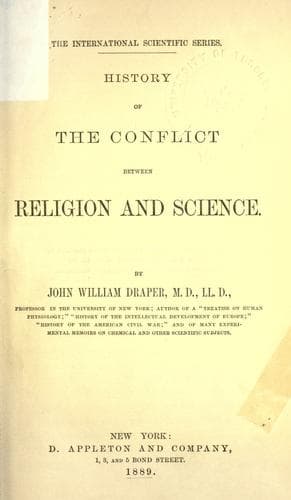
History of the Conflict Between Religion and ScienceDraper, John William
Religion
History of the Conflict Between Religion and Science
Draper, John William
Religion and science -- History
The foregoing paragraphs may serve to indicate the character of a
portion of the evidence with which we must deal in considering the
problem of the age of the earth. Through the unintermitting labors of
geologists, so immense a mass has been accumulated, that many volumes
would be required to contain the details. It is drawn from the phenomena
presented by all kinds of rocks, aqueous, igneous, metamorphic. Of
aqueous rocks it investigates the thickness, the inclined positions,
and how they rest unconformably on one another; how those that are of
fresh-water origin are intercalated with those that are marine; how
vast masses of material have been removed by slow-acting causes of
denudation, and extensive geographical surfaces have been remodeled; how
continents have undergone movements of elevation and depression, their
shores sunk under the ocean, or sea-beaches and sea-cliffs carried far
into the interior. It considers the zoological and botanical facts, the
fauna and flora of the successive ages, and how in an orderly manner the
chain of organic forms, plants, and animals, has been extended, from its
dim and doubtful beginnings to our own times. From facts presented by
the deposits of coal-coal which, in all its varieties, has originated
from the decay of plants--it not only demon strates the changes that
have taken place in the earth's atmosphere, but also universal changes
of climate. From other facts it proves that there have been oscillations
of temperature, periods in which the mean heat has risen, and periods
in which the polar ices and snows have covered large portions of the
existing continents--glacial periods, as they are termed.
One school of geologists, resting its argument on very imposing
evidence, teaches that the whole mass of the earth, from being in a
molten, or perhaps a vaporous condition, has cooled by radiation in the
lapse of millions of ages, until it has reached its present equilibrium
of temperature. Astronomical observations give great weight to this
interpretation, especially so far as the planetary bodies of the solar
system are concerned. It is also supported by such facts as the small
mean density of the earth, the increasing temperature at increasing
depths, the phenomena of volcanoes and injected veins, and those of
igneous and metamorphic rocks. To satisfy the physical changes which
this school of geologists contemplates, myriads of centuries are
required.
Public-domain text, read in full here on John Shaqi.
Reviews
Reviews
No reviews yet
Be the first to share your thoughts on this work.
Elsewhere in the archive
Join the Discussion
Join the discussion
Sign in to leave a comment or review.
Sign InorCreate an account