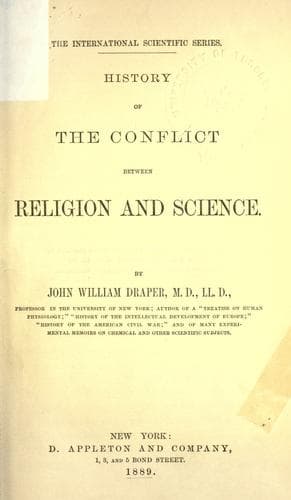
History of the Conflict Between Religion and ScienceDraper, John William
Religion
History of the Conflict Between Religion and Science
Draper, John William
Religion and science -- History
The lake-dwellings in Switzerland--huts built on piles or logs, wattled
with boughs--were, as may be inferred from the accompanying implements,
begun in the Stone age, and continued into that of Bronze. In the latter
period the evidences become numerous of the adoption of an agricultural
life.
It must not be supposed that the periods into which geologists have
found it convenient to divide the progress of man in civilization are
abrupt epochs, which hold good simultaneously for the whole human race.
Thus the wandering Indians of America are only at the present moment
emerging from the Stone age. They are still to be seen in many places
armed with arrows, tipped with flakes of flint. It is but as yesterday
that some have obtained, from the white man, iron, fire-arms, and the
horse.
So far as investigations have gone, they indisputably refer the
existence of man to a date remote from us by many hundreds of thousands
of years. It must be borne in mind that these investigations are quite
recent, and confined to a very limited geographical space. No researches
have yet been made in those regions which might reasonably be regarded
as the primitive habitat of man.
We are thus carried back immeasurably beyond the six thousand years of
Patristic chronology. It is difficult to assign a shorter date for the
last glaciation of Europe than a quarter of a million of years, and
human existence antedates that. But not only is it this grand fact that
confronts us, we have to admit also a primitive animalized state, and a
slow, a gradual development. But this forlorn, this savage condition
of humanity is in strong contrast to the paradisiacal happiness of the
garden of Eden, and, what is far more serious, it is inconsistent with
the theory of the Fall.
I have been induced to place the subject of this chapter out of its
proper chronological order, for the sake of presenting what I had to
say respecting the nature of the world more completely by itself. The
discussions that arose as to the age of the earth were long after the
conflict as to the criterion of truth--that is, after the Reformation;
indeed, they were substantially included in the present century. They
have been conducted with so much moderation as to justify the term
I have used in the title of this chapter, "Controversy," rather than
"Conflict." Geology has not had to encounter the vindictive opposition
with which astronomy was assailed, and, though, on her part, she has
insisted on a concession of great antiquity for the earth, she has
herself pointed out the unreliability of all numerical estimates thus
far offered. The attentive reader of this chapter cannot have failed to
observe inconsistencies in the numbers quoted. Though wanting the
merit of exactness, those numbers, however, justify the claim of vast
antiquity, and draw us to the conclusion that the time-scale of the
world answers to the space-scale in magnitude.
CHAPTER VIII.
CONFLICT RESPECTING THE CRITERION OF TRUTH.
Public-domain text, read in full here on John Shaqi.
Reviews
Reviews
No reviews yet
Be the first to share your thoughts on this work.
Elsewhere in the archive
Join the Discussion
Join the discussion
Sign in to leave a comment or review.
Sign InorCreate an account